
Up: Glassmaking

Lens Story: 6 of 28
|
|
| |
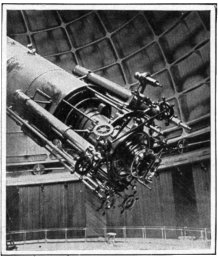 EYE-END OF LICK TELESCOPE
Lick Observatory, founded by James Lick,
is situated on
the summit of Mt. Hamilton, near San José,
California
|
and it is always upright. An ordinary mirror
gives an example of a virtual image. Both types of images are repeatedly
illustrated in optical instruments, as will be seen.
There are two main types of lenses, the converging
and the diverging. The convex lens belongs to the former class and
the concave lens to the latter. As shown in the
figure of on page 2, the double
convex object glass of Galileo's telescope converges the rays of light
from the object AB tending to produce a real image at ab. Before the rays
reach this position, however, they are diverged by the concave eyeglass
and are therefore made to produce a magnified virtual image at A'B'.
The eyepiece magnifies by apparently increasing the visual angle,
and, thus, by causing a distant object to appear larger, it seems to
be nearer.
Refracting Telescopes
From Galileo until very recent years
the refracting telescope has maintained the ascendancy, and it has
contributed most to the advancement of astronomical science. But,
very early in the making of telescopes, a serious obstacle presented
itself. Sir Isaac Newton discovered that prisms and lenses bend rays of
different colors unequally. The violet rays are refracted most and the
red least. Therefore the violet rays are brought to focus nearer the
object glass than the red rays and the whole image is surrounded with a
fringe of color. But by grinding lenses almost flat and of very great
focal length this difficulty was largely overcome.
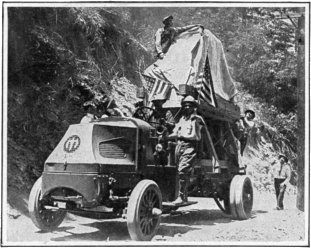 TRANSPORTING THE 100-INCH REFLECTOR FOR THE
SOLAR OBSERVATORY OF THE CARNEGIE INSTITUTION
To the top of Mt. Wilson (6,665 feet),
near Pasadena, California
|
Another and ever more
serious difficulty, however, immediately appeared, for these flat lenses
necessitated very long and unwieldy
telescopes awkward to manipulate and requiring a prodigious amount of
time and patience in their use. Telescopes were built over two hundred
feet in length and with no tube connecting object glass and eyepiece.
In one such telescope built by Huygens the
object glass was mounted in a small swivel on the top of a tall pole
and secured in position by a rope held taut by the observer, who also
held the eyepiece in his other hand. Needless to say very little useful
observation could be made with such a telescope.
In 1733
Chester More Hall and later, in 1755,
John Dollond, two English
|
|


