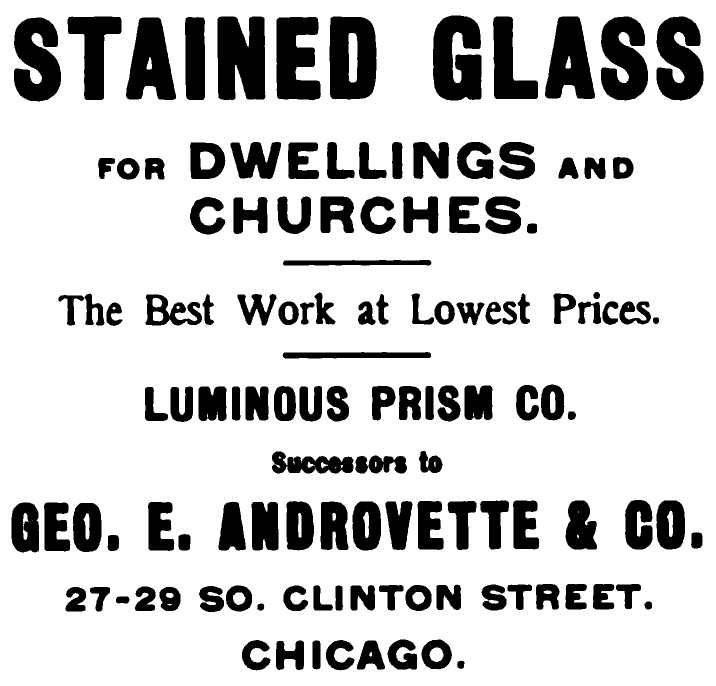
... Successors to GEO. E. ANDROVETTE & CO. ...
Location:
Timeline:
Geo. E. Androvette & Co:
- Advertising said Luminous Prism Co was
successors to Geo. E.
Androvette & Co , but their existence overlapped. They also
had the same Chicago address, and Androvette was listed as a director
of Luminous Prism Co.
- "Androvette George E. ornamental glass, S. Clinton, nw. cor. Jackson,
T. 4085" —A. N. Marquis & Co.'s Handy Business Directory of Chicago · 1886-1887
- "Stained Glass. ANDROVETTE GEO. E. & CO. Clinton sw. corner Quincy"
—Chicago City Directory · 1889
- "Stained Glass Makers. Androvette Geo E 139 E Lake Chi'go"
—Directory of Architects · 1890
- "George E. Androvette & Co. established their leaded glass
works on Quincy and Clinton streets. Beveled plate glass, set in
lead and copper frame, is one of their specialties." —Industrial Chicago · 1891
- "The Linden Glass company signed the agreement of the Lead Glaziers'
and Glass Cutters' Union yesterday. The Wells Glass company, George
E. Androvette, Chicago Art Glass company, H. M. Hooker, Camp Glass
company, and H. Sherhart, seven of the largest firms in this city, have
also granted the union's demands. The men employed in William Ebert's
shop at No. 546 West North avenue were called out and stopped work
yesterday morning. The Eugene Glass company at No. 1305 Michigan avenue,
which employed fifty men, still refuses to accede to the union's terms."
—Chicago Tribune · May 6, 1892
- "Group 95. Stained Glass in Decoration. 274. Androvette, Geo. E.,
& Co., Chicago. Decorative glass. Gal. F-13 596. Domestic and
ecclesiastical glass workers. Memorial windows, brasses, etc. Beveled
plate glass set in a copper frame." —World's Columbian Exposition, 1893: Official Catalogue
- "GEORGE E. ANDROVETTE & CO. show in their exhibit some portrait
work of a high order of merit. Messrs. Androvette & Co. have for
some years past devoted special attention to ecclesiastical work, and
have brought this art to such perfection that their products are in
demand in every part of the country. Their exhibit shows some recent
designs in this line that are very creditable. In their treatment
of opalescent glass they are particularly skillful. The peculiar
brilliancy of that glass admits of the most pleasing treatment
in the shading and blending of colors, to produce either floral,
pictorial or landscape effects without the aid of painting. The art
is thus seen to be practically limitless. It requires only the skill
of the artist and the long study such as Messrs. Androvette &
Co. have devoted to it to produce the best possible results."
—The Inland Architect and News Record · Volume 22, Issue 3, September, 1893
Ads:

|
|
IS your Store or Office Dark?
Luminous Prisms
will change the condition.
They
CARRY DAYLIGHT.
|
It costs nothing to investigate.
Telephone us or send card,
and we will survey your
premises and submit
proposition, guaranteeing
results as represented.
|
Luminous Prism Co.
709 Mohawk Building, 160 5th av.
Telephone—2816 18th st.
The Sun (NY) · April 4, 1898
|
Notes:
- "Luminous Prism Company ... 27 South Clinton Street. Patent Lights."
—Catalogue of the Seventh Annual Exhibition · Chicago Architectural Sketch Club · 1894
- "The Luminous Prism Company, of Chicago organized recently with an
authorized capital of $1,500,000, has the following board of directors:
Clarence L. Peck, George E. Androvette, Parry L. Wright, Alexander H.
Revell, Albert R. Barnes, Jonathan W. Brooks, Lewis C. Straight and
Ferdinand W. Peck. The Offices of the company are in the Chicago Stock
Exchange building, and branch offices have been established in all
the leading cities of the country." —Railway and Engineering Review
· May 14, 1895
- "Androvette George E. (George E. Androvette & Co.) 27 S. Clinton,
h. Evanston" and "Androvette George E. & Co. (George E. Androvette
and Parry L. Wright) glass 27 [and 29] S. Clinton" —Chicago City Directory · 1896
and 1897.
- "The Luminous Prism Company, organized recently with an authorized
capital of $1,500,000, have the following Board of Directors:
Clarence I. Peck, George E. Androvette, Parry L. Wright, Alexander
H. Revell, Albert R. Barnes, Jonathan W. Brooks, Lewis C. Straight
and Ferdinand W. Peck. The offices of the company are located on the
sixth floor of the Chicago Stock Exchange Building and the factory
is at 27 and 29 South Clinton street, Chicago. They have established
offices in New York, Philadelphia, Boston, Pittsburgh, Cincinnati,
Cleveland, Columbus, Indianapolis, St. Louis, Minneapolis, Kansas City
and San Francisco. The company are meeting with unusual success in
the introduction of their product. known as the luminous prism. which
is manufactured under United States letters patent, dated 1891, owned
by the company."
—Iron Age · May 5, 1898
- "LUMINOUS PRISMS. Architects and builders, who have been from
time to time nonplussed by their inability to obtain sufficient light
in buildings, owing to various conditions, such as narrow streets and
extreme depth of buildings, and especially in locations where the
land value is a matter of great consequence, are requested to give
their attention to the system of light production of the Luminous
Prism Company, who have very recently opened a New York office at
No. 160 5th avenue. The parent office of the company is in Chicago,
and among its incorporators are included some of the leading business
men of that city. Convinced of the large field for the consumption of
their goods, growing out of the necessity for the supplying of more
light in the larger buildings of this city, they have established
their eastern agency at the above address. Mr. J. F. Blanchard is
the resident eastern agent, and he is prepared at all times to submit
drawings and estimates to architects and builders for the introduction
of their system. The company, in its method, take advantage of the
natural laws of the transition of light from one transparent medium
to another through the use of refracting prisms, which are made with
various angles, by means of which they are able to direct the light
on any desired plane. The prisms do not create light, but intensify,
concentrate and direct it from one point to another. The company
claims many advantages from the use of its system, among them economy
and the superiority of natural light, with its healthful properties,
over that of electricity or gas. They own their patent rights, and,
with their superior facilities for manufacture, are in a position
to produce the best results." —Real Estate Record and Builders' Guide · Volume 61, March 26, 1898
- "THE GREAT EFFECTIVENESS OF LUMINOUS PRISMS. A decidedly good
illustration of the results obtainable in using the new luminous
prisms, manufactured by the Luminous Prism Company, Chicago Stock
Exchange building, is to be seen in the Security building, southeast
corner of Madison street and Fifth avenue. The second and third
floors of the Security, two of the best floors in the building,
and adapted for use by financial institutions or large corporations,
have been fitted with luminous prisms. The effect is daylight in every
part of the entire floor and every foot of space is now available for
office use, a condition which did not prevail before. A great saving
in the expense incurred in using electric and gas lights will thus
be made. The Luminous Prism Company are prepared to turn out work
promptly and efficiently, and a request by telephone or otherwise
will bring a competent representative to estimate for the proper
lighting of any premises desired." —The Economist
· Volume 19, April 30, 1898
- "THE NEW LIGHT. One of the most marvelous triumphs of applied
science is shown by the Luminous Prism Company in successfully
lighting by the use of their window prisms the two darkest rooms
in the Security building at Madison street and Fifth avenue. The
construction of the Elevated Loop line station building and platform
on Fifth avenue cut off the light almost entirely from the second
and third floors, causing the tenants to vacate them on account
of their somber condition. Now all this is changed, and by means
of
Luminous Prisms, set in wrought-iron frames outside of
the windows, a most brilliant illumination is obtained, doing away
entirely with artificial light during business hours. The light
delivered is of a beautiful clear white color and great intensity,
but it is so evenly distributed throughout the entire interior that
there is no glare or strain on the eyes. This is a notable example of
the application of old and well-known principles to practical uses,
and the cost of installation is brought down to a point where it is
no longer a luxury enjoyed by the few, but is now within the reach
of everyone who desires more light. A visit to the Security
building, or to the Luminous Prism Company's offices, 601-608 New
Stock Exchange building, will well repay the trouble."
—The Economist · Volume 19, May 7, 1898
- "WHAT LUMINOUS PRISMS DO—AND HOW THEY DO IT. Luminous
prisms carry daylight into dark areas, thus at once doing away with
artificial light during business hours, which alone effects an economy
that in a short time offsets the original cost. In a word, Luminous
Prisms save health and money and increase comfort and rentals. This
splendid result is obtainable through the use of the natural law of
refraction, as the Luminous refracting prisms are made with various
angles by means of which light is directed on any desired plane. Any
inquiry directed to the main office of the Luminous Prism Company,
601-608 Stock Exchange building, will receive prompt attention."
—The Economist · Volume 19, May 14, 1898
- "MARVELOUS EFFECTS OF LUMINOUS PRISMS. The comparative merits
of daylight as against artificial light are practically illustrated
by the remarks of various parties for whom these prisms have
been placed. H. C. Metcalf, of the Metcalf Stationery Company,
86 Wabash avenue, says:
We find it saves us practically all
the gas we formerly used on the sixth floor, and over one-half on
the first floor, besides which the daylight enables us to judge of
tints and colors of stock and ink, as we were unable to do before,
and the effect upon the eyes of our work people is no longer trying
as formerly. Cameron, Amberg & Co., 71 and 73 Lake street,
say: Natural light being the most desirable in a printing
room, it pleases us very much to know that we can cut off nearly
half of our artificial light. This insures better work, and saves
considerable in the light bill, both important items with us.
Important installations of Luminous Prisms are now being made
in Boston, New York, Philadelphia, Indianapolis and other cities."
—The Economist · Volume 19, May 21, 1898
- "NEW METHODS OF LIGHTING DARK INTERIORS. A notable illustration
of the value of the new methods of lighting dark interiors is shown
in the two stores occupied by Harry Berger & Co., 154 and 150 Dearborn
street, which have recently been installed with luminous prisms by the
Luminous Prism Company, 601-608 Chicago Stock Exchange building. It
will be apparent to a casual observer that the principles involved
in the luminous prisms have superior lighting qualities to any other
prism glass. It will be seen that the light is beautifully and evenly
distributed over the entire room, and that during daylight hours the
need for artificial light is obviated. It should be considered that
the rental value of any store of this character would be largely
enhanced by this superior method of lighting, and that the textile
goods intended to be shown in this store will show their shades and
colors exactly as they are. This is not the case with artificial
lighting." —The Economist · Volume 19, June 11, 1898
- "Daylight vs. Darkness. A new window or window shade has
been placed in the front of the Thorn-Halliwell Cement Company,
No. 107 East Tenth street, and it attracts much attention. It is
a window made of refracting prisms by the Luminous Prism Company,
of Chicago. These prisms represent the highest science of light.
Advantage Is taken of the natural law of refraction and by an
ingenious arrangement of angles in the surface of the glass the
light is thrown to various parts of the room, changing the dark
corners to light ones. The advantage of daylight over any other
kind of light is known to everyone. It is the cheapest, the best,
the healthiest. Luminous prisms have solved the problem of lighting
dark offices and basements. The effect is almost startling when
the darkness changes to light as the prism shutters are opened
or closed. Those who are interested in solving the light or dark
question can obtain information at No. 107 East Tenth street,
where visitors are welcomed." —Kansas City Journal · June 15, 1898
- "Luminous Prisms. To be conducted into a dungeon like cellar,
grope about in the dark, and suddenly to find it illuminated, not by
gas or electricity, but by pure rays of light reflected from the sky,
seems somewhat astonishing, yet this is what a representative of
The Insurance Press experienced when be visited the exhibit of the
Luminous Prism Company, 604 Broadway. The effect was not produced
by the opening of a shutter but by the simple pulling of a cord and
suspension at an angle of the modern reflector—a combination of
brilliant squares of light.
These prisms are coming into more
general use every day. Fire insurance companies will be interested
to learn that the reflector is composed of squares of glass with
the double prisms on the surface, which can be replaced separately
at very small cost." — The Insurance Press · June 22, 1898 - "IMPORTANT TO OWNERS AND TENANTS. The attention of owners and
tenants is called to the new methodsof illuminating dark interiors
as shown in the stores occupied by Morrisson, Plummer & Co.,
200 Randolph street, Cameron, Amberg & Co, 73 Lake street,
and Bullard & Gormley Co., 78 Randolph street, which have been
recently installed with luminous prisms by the Luminous Prism Company,
601-608 Chicago Stock Exchange building. The luminous prisms have had
the effect of transforming the formerly dark interiors of these stores
into light and commodious quarters. The light is evenly distributed
over the entire space, and during the daylight hours the need for
artificial light is obviated. Owners will both greatly enhance the
rental value of their property and decrease the cost of lighting by
the use of luminous prisms." —The Economist · July 23, 1898
- "Light in the Darkness. Luminous prisms are in demand. Owners of
old buildings and architects of new ones are realizing the fact that
a ray of light cast upon the luminous prisms down an air shaft or
basement however deep will turn a dungeon-like room or cellar into
a delightful sunlit apartment. This is no exaggeration. Luminous
prisms save gas and electric light. The Manhattan State Hospital,
Christ Hospital in New Jersey, and the Ellis Island Hospital are to
be fitted with luminous prisms. Scientific medical men recognize the
necessity of light for the patients of the hospitals. Light is life
and health, and luminous prisms will give it as well as increase
the value of property and reduce the gas bills." —The Insurance Press · September 28, 1898
- "Luminous Prisms. The Bank of Montreal and the offices of Mr. James Brown Potter have lately been fitted up with prisms—luminous prisms.
A representative of THE
INSURANCE PRESS called at Mr. Potter's
office to examine the prisms and learn by ocular demonstration the
modus operandi by which these prisms gather the sunlight to
reflect it into rooms and comers hitherto dark and dismal.
Mr. Potter was evidently well pleased
with the effect of the prisms, and proved to our representative that
when the prisms were not in evidence at the windows his offices are
dark enough to render gas or electric light a necessity. When the
prisms are in place, however, the change is marvelous. Neither gas nor
electricity is necessary; instead, a flood of beautiful sunlight pours
in and makes every corner bright as day. There are no dazzling rays,
but a soft white light, exceedingly pleasant in its effect.
There, said Mr. Potter, You see
the effect betwixt prisms and no prisms. They make a great improvement
here, as you can judge for yourself. Now, go and examine those in
the Bank of Montreal on the ground floor.
This our representative did, and
found the effect even greater, on account of the larger number
of prisms.
These luminous prisms can be utilized
with wonderful effect in the lighting up of basements, cellars
and rooms, where the direct rays of the sun cannot penetrate. By
their use property can be greatly increased in value apart from the
consideration of health, comfort and economy." — The Insurance Press · October 26, 1898 - "Gee Allison W. mngr. Luminous Prism Co. 102 Superior, r. 166 Huron" —Cleveland City Directory · 1899
- "The Lindeke Land Company's building on Robert st. will have a
full sidewalk equipment of Luminous Prism Company's glass, and will
secure by their aid sufficient daylight in the basement to read a
newspaper 100 feet back. They are also to have the Luminous Company's
high grade prism glass in the show window transoms. Herman Kretz &
Co., architects." —Improvement Bulletin · Volume 20, September 23, 1899
- "Luminous Prism Co ... [Incorporated in state of] West Virginia
... [Date when certificate of authority was issued] August 2, 1899"
—List of foreign corporations who have authority to do business in the state of New York, 1901
- "LUMINOUS PRISM COMPANY—Incorporated under the laws of Illinois,
in 1898, to manufacture prisms of all kinds. Capital authorized,
$1,500,000. Par, $100. Officers and Directors: F. W. Peck, President;
P. L. Wright, Treasurer; L. C. Straight, Secretary; C. I. Peck,
G. E. Androvette, J. W. Brooke, A. R. Barnes, A. H. Revell. Office,
604 Broadway, New York." —Moody's Manual of Industrial and Miscellaneous Securities · 1900
- "Luminous Prism Co., 520 Olive" —Gould's Commercial Register (business Directory) of the City of St. Louis · 1900
- "Luminous Prism Co, 27-29 Clinton st", "Females over 16 years: 1",
"Males over 16 years: 28" —Annual Report, Illinois. Dept. of Factory Inspection · 1900
- "The contract for the art for Emmaus Lutheran church was let to
the Luminous Prism Company, of Chicago, their bid being $900."
—The Fort Wayne Evening Sentinel · March 1, 1900
- "Luminous Prism Co, 730 Chestnut" —Boyd's Co-partnership and Residence Business Directory of Philadelphia City · 1900
- "George M. Webster and Thomas J. Parkes have registered as partners
under the style of The Luminous Prism Co., Montreal."
—Canadian Hardware and Metal Merchant · Vol. XXI, No. 1, January 6, 1900
- "Luxfer Company Making Luminous Prisms.
The Luminous Prisms formerly manufactured for purposes of interior
lighting by the Luminous Prism Company are now the property of the
Luxfer Prism Company, whose Luxfer Prisms and their application
to school-room lighting were described in the last School Board
Number of The School Journal. With the Luminous Prisms goes the
very interesting little pamphlet
Natural Light for School-Rooms.
This ought to be in the hands of every student of school hygiene. The
subject is one of fundamental importance."
—The School Journal · Volume 62, January 5, 1901
- "Luminous Prism Co. (dissolved) 473 W. B'way"
—Trow's Copartnership and Corporation Directory of New York City · 1901
New mentions:
- "Meyer J. Sturm (1872-1954) was a nationally renowned specialist
in hospital design and expert in the latest technologies for
institutional buildings. He received a B.S. in Architecture from the
Massachusetts Institute of Technology in 1896. In Chicago he worked
as a draftsman and superintendent for various architects, then as
chief engineer for the Luminous Prism Co. from 1898 to 1900. From
1900 to 1902 he was in partnership with Lawrence Gustav Hallberg,
an architect of Swedish descent who later designed Augustana Hospital
in consultation with Sturm." LANDMARK DESIGNATION REPORT · North Chicago Hospital Building · 2009 (PDF)
- Union Station (1001 Broadway, Nashville, TN): "The Luminous
Prism Company, Chicago, Illinois, furnished and placed all the art
glass in the dome, transom, and windows from special and appropriate
color and design. The designer is not specified."
—Historical American Buildings Survey · 2011 (NPS PDF)
- "From 1995 to 2002, the county spent $8.6 million, most of
it from private donors, restoring the Allen County Courthouse
— among other things, removing the damage inept artists had
done to the murals far above the floor. ... In all, it will
cost about $350,000 to make the repairs to the murals, created
by Charles Holloway, who had won a gold medal in the Chicago
World's Columbian Exposition, and to the windows, created
by Luminous Prism Co., a direct competitor of Louis Comfort Tiffany."
—The Journal Gazette · 2017
Paper:
- Luminous prisms: how and where they have served others and how they will serve you.
- Geo. E. Androvette & Co., 27-29 So. Clinton St., Chicago, Ill: Ecclesiastical Glass Designers & Makers of Memorial Windows, Either in Opalescent Glass Effects Or in the European Methods of Glass Painting (Google Books)
Stained Glass and Glass Mosaics:

|
|
LUMINOUS PRISM COMPANY
SUCCESSORS TO
Geo. E. Androvette & Co.,
DESIGNERS AND MAKERS OF
MEMORIAL AND FIGURE WINDOWS.
MEMORIAL
BRASSES |
SEND FOR PHOTOGRAPHS
SHOWING WORK IN PLACE. |
27 and 29 South Clinton Street, CHICAGO, ILL.
Living Church Quarterly · December 1, 1899
|

|
|
STAINED GLASS
FOR DWELLINGS AND
CHURCHES.
The Best Work at Lowest Prices.
LUMINOUS PRISM CO.
Successors to
GEO. E. ANDROVETTE & CO.
27-29 SO. CLINTON STREET,
CHICAGO.
Inland Architect and News Record · 1900
|
- See stained glass examples at the Michigan Stained Glass Census
- First Congregational Church, Olivet, Michigan
- Central Congregational Church, Galesburg, Illinois
- "There are 75 stained glass windows ranging in size from 3 square
feet to 1,080 square feet. They were made by the Luminous Prism Co. of
Chicago, successor to the Geo. Androvette Co. The largest, of 1,080
square feet, fills the north wall of the auditorium. There are three
sections with painted glass centers of lilies, grapes, palm fronds and
passion-flowers. At or near the top the window are, from left to right,
a dove, a crown and a sheaf of grain. The remainder of the window is
comprised of small panes of varied colors and shapes. Also included
in strategic locations are red and yellow
jewels ." —Construction of the Central Congregational Church Building
- "Built in 1898 of Michigan red sandstone in the Richardson Romanesque
style, Central Congregational Church, located one block north of
Standish Park, was placed on the National Register on Sept. 30, 1976.
The church covers nearly a quarter of the block and its bell tower
rises to 137 feet. It has 75 stained glass windows ranging in size
from 3 square feet to 1,080 square feet, made by the Luminous Prism
Co. of Chicago. The largest window has three sections and fills the
north wall of the auditorium." —The Construction of Central Congregational Church (archive.org)
- St. Peter's Episcopal Church, Rome, GA
- The Guardian Angel Window / Located in the Church / Given in 1898 by Mr. W. A. Knowles,
in memory of Mrs. May H. Knowles / Made by Luminous
Prism Co., Chicago, IL at a cost of $225 / Twice partially
destroyed by storms / Present window made entirely new
in 1910
- The Perkins Window / Located in the Church /
Given in 1898 by Mrs. John N. Perkins family /
Made by Luminous Prism Co., Chicago, IL at a cost of $52 /
Inscriptions on windows - John N. Perkins &
Mary E. Perkins
- The Resurrection Window / Located in the Church / Given in 1898 by the congregation
and others in memory of Rev. W. C. Williams, D.D. /
Made by Luminous Prism Co., Chicago, IL at a cost of $52
- The Underwood Window / Located in the Church /
Given in 1899 by Mrs. M. A. Nevin and sisters / Made by
Luminous Prism Co., Chicago, IL at a cost of $65 /
Inscriptions on windows - John W. H. Underwood,
Mary W. Underwood, William H. Underwood
- Windows by Geo. E. Androvette at St. Peter's Episcopal Church, Rome, Georgia:
The Ascension Window,
The Eastman Memorial Window,
The Graves Memorial Window,
The Walton-Knight Memorial Window,
The West Memorial Window.
- Other windows are mostly by:
- Lyn Hovey Studio, Inc., Boston, MA;
also Quaker City Stained Glass Co., Philadelphia, PA,
Empire Art Glass Co., Atlanta, GA, H. M. Hooker Co., Chicago, IL,
Agnew Myers Studio, Menlo, Georgia, Otto Jungk
MOSAICS.
OBSERVERS, Says Mr. George E. Androvette,
have frequently remarked the vast amount of colored glass used
during the past ten years. Starting with the Queen Anne period of
architecture, with its little panes of primitive colors inharmoniously
arranged, and progressing through various stages of leaded glass to
the last four years, during which have appeared the most startling
combinations of colored glass, beveled plate glass and jewels arranged
to catch the fancy of the uneducated eye. This kind of work has been
used with the most indiscriminate profusion, often regardless of cost
or propriety. In fact, the artistic sense is rarely gratified by
seeing a piece of glasswork accomplishing the purpose for which it
should be used. The demand for this doubtful sort of decoration has
caused what should be an art industry simply to become a mechanical
pursuit. It is hardly known and little appreciated, however, that
it requires as full a knowledge of correct drawing and composition
and a finer sense of color to produce successful glasswork than
in decorative painting. Recently, it has appeared that the fear
of the abuse of color has caused many architects and buyers to
eschew colored glass, and to use various forms of crystal glass,
and also beveled plate in ornamental shapes. The first answers
fairly well in some positions; the last is a doubtful resource
from an artistic standpoint. Here we wish to urge that color only,
colors harmoniously blended and adapted to their surroundings, must
be used to fill certain places in a house to give the true decorative
value to glass. That colors have been so used cannot be gainsaid;
but such work must be made by those who have gained the knowledge
by years of experience, and who possess the love of the artist for
his work. Until the artist's remuneration is commensurate with his
success as a decorator in the true sense, rather than a measure of
the cost of materials and labor used, we will still have the same
state of things as before.
The Inland Architect and News Record · Vol. XX, No. 6, page 68, 1887
|
GLASS-WORKING AS AN ART.
BY GEORGE E. ANDROVETTE.
THE art of working in stained glass is one for which a
renaissance is claimed for the present century. It must be confessed
that, with the increased variety of sheet glass now at the command of
the artist, the possibilities are greater in pure mosaic work.
The earliest glasswork were pure
mosaics. From these the progress of glass painting may be traced through
a history of slow development to a culmination of great splendor in the
fifteenth century. From this there was a decline, owing to the mistaken
attempts to assimilate this art to other branches of painting. All
this goes to prove glass-working to be an applied art, and too evident
attempts at realism must surely result in a deterioration of the art as
a mosaic, and it is only as a mosaic that any promises of a renaissance
in America is in evidence. It is principally through the discovery and
adaptation of the opalescent and shaded glass, by Mr. La Farge, that
great possibilities have been opened to the artist in this method of
work. The greatest obstacle, however, at present is the excessive use
by the American public of a low grade of ornamental glass-work. This
demand has induced a large number of persons, having no knowledge of art,
to enter into the manufacture with the inevitable result of a lively
competition to produce cheap work, and, consequently, lower the standard
from an art to that of a mechanical process. This, necessarily, precludes
the employment of the best artists, who find remunerative exercise for
their talents in other arts.
As the art of glass-working has been the
least written about, and is the least known of all decorative arts to
the general public, it would seem that the proper method to elevate the
art would be to educate the people as to what is proper and correct in
this branch, as has been done in painting, tapestries, and other forms of
decoration. This can best be done by viewing examples of good work done
under the various processes. Much also can be done by making glasswork
more of a subject of description, as is done in other branches.
It is true that there are but few
competent writers on the subject, as both the technical knowledge and
descriptive ability are demanded. It is believed, however, that as the
modern newspaper caters to the demand of the public for information
and criticisms on literary, dramatic and art work, descriptions and
criticisms on glasswork would be acceptable.
Without making this an encyclopedic article,
a few ideas are here outlined : Believing, first, that the mosaic glass
composed of small pieces of various colors and shades inherent in the
glass so selected, arranged and joined together as to form a complete
picture is a true treatment of glass, yet it is admitted that many parts
demand the use of the brush, such as the illustrating of the flesh and
draperies of figures, architectural accessories, etc. A combination
of the European system of glass painting in the composition of the
picture demanded can be well framed in ornamental accessories in the
mosaic style.
To those, however, who demand the realism
of a mural painting, a subject may be wholly painted. There are two ways
of doing this : First, to paint on clear glass, using enamel colors
of various tints. (This is what was done in the decadence of the old
glass painting.) Second, to first select the colors of glass needed to
emphasize the various parts of the work. Then to paint them by applying
one color uniformly and afterward removing this color by degrees so as
to develop the high lights and exposing the natural colors of the glass,
thus producing lights and shades to any desired degree. This last seems
the true method of glass painting, and best develops the colors inherent
in the glass itself.
The Inland Architect and News Record · Vol. XX, No. 6, page 16, 1887
|
THE ANDROVETTE ART GLASS COMPANY.
The art stained and ornamental glass
interests of the United States have developed to enormous proportions
within the last quarter of a century and constitute at the present time
one of the leading departments of industrial and commercial activity in
this country. The transactions in these products in Indianapolis and the
surrounding sections in the course of a year are of great importance and
value to the trade and commerce of the city, and there are represented
here several notable concerns engaged in this artistic industry. Prominent
among such stands the Androvette Glass Company of Chicago, manufacturers
on a most extensive scale of art stained ornamental glass for churches,
dwellings, or public buildings, making a specialty of copper frames.
The state representative hereof this vast and reliable concern is
Mr. Edward Schurmann, who occupies an elegantly furnished suite of
offices in the Odd Fellows' Building. Mr. Schurmann established himself
in this line of business in Indianapolis about the year 1872. He first
represented in this city the Chicago Art Glass Company, then the Wells
Art Glass Company and finally allied himself to the Androvette Company,
which he now so efficiently represents. He does a large business handling
the unrivaled products of his house. For originality, beauty and variety
of designs, excellence of material and thoroughly artistic productions
in stained glass, or for promptness and reliability in executing orders,
none in the line indicated sustain a better reputation than the Androvette
Company. This concern is certainly a foremost exponent of this branch
of art in the west, turning out a distinctly superior class of work,
and having a large and growing patronage extending throughout the United
States. The facilities of the company are first-class in all respects,
and their establishment is the largest and best equipped in this section
of the country. Through Mr. Schurmann this house furnished all the art
glass for many of the prominent churches and public buildings here, and
the private residences of our wealthiest and most influential citizens.
Mr. Schurmann has on display at his office samples of all kinds of glass
doors and other art productions in most beautiful and unique designs,
which he will set as desired in copper, gold, silver, brass or any other
metal indicated. Special designs are made to order, embodying every wish
of patrons, which will be guaranteed as exclusive, if so required, and
will not be duplicated unless by permission. He is prepared to furnish
designs and estimates for anything in his line and guarantee the utmost
satisfaction. The prices charged are of the most reasonable character
and all work coming through Mr. Schurmann is sure to be executed in
the highest style of art He is a native of Indianapolis and one of
our prominent and most esteemed citizens. He is a gentleman of ripe
experience and judgment in his line, and has spent several years in
Europe studying the business among the leading art glass manufacturing
centres there. He enjoys a large and influential patronage, and is most
eminently deserving of his great prosperity."
Indianapolis Illustrated · 1893
|
Legal:
|
Suit was brought in the Superior Court at Chicago on the 18th
inst. by the American Luxfer Prism Company against the Luminous Prism
Company for an injunction to restrain it and its officers from alleged
fraudulent business methods in the manufacture and sale of prismatic
window glass. The officers of the Luminous Prism Company, Fred. W. Peck,
president; George E. Androvette, vice-president; Lewis G. Straight,
secretary; Parry L. Wright, treasurer, with Jonathan W. Brooks and
Alexander H. Revell, directors, are made co-defendants in the suit. The
plaintiff alleges that the defendant company is carrying on its business
by a wrongful infringement upon the name and trade mark of the American
Luxfer Prism Company and is deceiving the public into the belief that
its window glass is the same as that manufactured by the plaintiff. It
is further alleged that for this purpose the Luminous Prism Company has
taken offices in the same building with the plaintiff. The court is
asked to enjoin the use of the words "Luminous Prisms" and the name of
"Luminous Prism Company."
Paint, Oil and Chemical Review · Volume 26, No 1, July 6, 1898
|
LUMINOUS PRISM COMPANY.
It Promises Protection to Its Customers in Infringement Suits.
Referring to an article in last week's issue
regarding the Luxfer prism, the Luminous Prism Company positively state
that the patents under which the company is operating do not infringe any
patents, and that the company will absolutely protect its customers in
every way. They claim that the diffusion of light by using the corrugated
prism based on their patent of 1891 is considerably greater than that
of any other prism in the market. The Luminous company also state that
they have been instrumental in materially reducing the price of prisms,
and placed them in the reach of all who wish to enjoy the benefits that
come with daylight in dark rooms, stores or offices. It is probable that
a more comprehensive statement upon the subject will be made in an early
future issue of this paper. The Luminous company certainly has strong
men behind it, who enjoy the confidence of the community.
The Economist · Volume 20, August 20, 1898
|
A STATEMENT BY THE LUMINOUS PRISM COMPANY.
In view of certain statements recently made by a competitive company,
concerning its patents, the Luminous Prism Company informs the public
that its patents of 1891 antedate all other patents now used in the
manufacture of prism glass.
A number of the most eminent patent law firms of the country have
rendered opinions that the patents under which the Luminous company
is operating do not and cannot in any way infringe upon any other
patents.
The Luminous company certainly has strong men behind it, who enjoy
the confidence of the community, and who will absolutely protect its
customers in every way against claims for infringements.
The Luminous prism is declared by experts to be the best prism in
the market, the refraction and diffusion of light by reason of its
corrugated prism patent, No. 458850,
dated September 1, 1891, being 25 per cent greater than any other.
The Luminous Prism Company has endeavored to pursue a "live and
let live" policy, and to that company should be given the credit of
materially reducing the price of prisms, thereby placing them within
reach of all who wish to enjoy the benefits of daylight in dark rooms,
stores and offices. Prior to the appearance of this company such benefits
were almost prohibited by a practical monopoly.
Among the large number of installations already made, the following
names will show that there are many who refuse to be intimidated in
the exercise of their vested rights, and who encourage competition,
enterprise and advancement:
- Security Deposit Company, Madison street and Fifth avenue.
- Potter Palmer, for Baptist Publication Society, 177 Wabash avenue,
Chicago.
- Cameron, Amberg & Co., 71 and 73 Lake street, Chicago.
- C. Seipp Brewing Company, Twenty-seventh street and Illinois
Central Railroad, Chicago.
- Laflin & Rand Powder Company, 42 Dearborn street, Chicago.
- Morrisson, Plummer & Co., 200 to 206 Randolph street, Chicago.
- Rialto building, Van Buren street and Pacific avenue, Chicago.
- Harry Berger & Co., 154 and 156 Dearborn street, Chicago.
- Eckhart & Swan, 207 and 209 East Madison street, Chicago.
- Metcalf Stationery Company, 86 Wabash avenue, Chicago.
- Lanz, Owen & Co., 183 to 189 Lake street, Chicago.
- Garrett Biblical Institute, 234 East Lake street, Chicago.
- A. H. Revell & Co., Wabash avenue and Adams street, Chicago.
- 4731 Calumet avenue, Chicago (fiat building).
- E. J. Alfeld, 201 Rush street, Chicago.
- Chicago Stock Exchange building, Washington and La Salle streets,
Chicago.
- C. McClennen, 3822 Ellis avenue (flat building), Chicago.
- L. B. Schaefer, 1047 North Clark street, Chicago.
- J. M. Studebaker, South Bend, Ind. American Baptist Publication
Society, St. Louis, Mo.
- Smith-Premier Typewriter Company, 337 Broadway, New York.
- Rhinelander Estate, 604 Broadway, New York.
- George Bickelhoupt, 234 West Forty-seventh street, New York.
- Richards Bennetts, 133 William street, New York.
- Glascoe & Co., 52 West Thirty-ninth street, New York.
- Eaton & Mains, Fifth avenue and Twentieth street, New York.
- Best & Co., New York.
- German Fire Insurance Company of Indiana, Indianapolis, Ind.
- New Bedford Institution for Savings, New Bedford, Mass.
- W. A. Giles, 298 and 300 Wabash avenue, Chicago.
- Northwestern University Dental School, Madison and Franklin
streets, Chicago.
- Chicago, Burlington & Quincy Railway Company's general
office building.
- E. B. Quinlan, 218 Washington street, Chicago.
- Jacob Franks, 128 and 130 Franklin street, Chicago.
- J. M. Williams, Fifth avenue and Madison street, Chicago.
- R. W. Patton, apartment building, Chicago.
- J. B. Hobbs, 97 Washington street, Chicago.
- Hartford building, Dearborn and Madison streets, Chicago.
- Mead & Coe, 100 Washington street, Chicago.
- Estate L. C. P. Freer, 78 and 80 Randolph street, Chicago.
- Royal Insurance building, La Salle and Jackson streets, Chicago.
- M. L. Barrett, 219 Lake street, Chicago.
- Francis Bartlett, Bay State building, 74 State street, Chicago.
- Estate Hugh T. Dickey, 84 and 86 Dearborn street, Chicago.
- L. Schlesinger, factory, Rees street, Chicago.
- Thomas A. Lyon, Lyon, Gary & Co., Chicago.
- First National Bank, Cleveland, Ohio.
- J. Spalding & Co., Detroit, Mich.
- Charles L. Smith & Sons, Cincinnati, Ohio.
- New York Telephone Company, New York.
- Bank of Montreal, New York.
- National Exchange Bank, Albany, N. Y.
- Bank of Syracuse, Syracuse, N. Y.
- Ladies' Home Journal, Philadelphia, Pa.
- William Mann & Co , Philadelphia, Pa.
- J. B. Stetson & Co., Philadelphia, Pa.
The Economist · Volume 20, August 27, 1898
|
|