
Up: Luxfer Prism

1906 Sweet's
7 of 9
|
|
| |
| CONSTRUCTION. |
The series of circular lenses two and
three-quarters in diameter is placed in longitudinal and transverse rows
three and five-eighths inches between centers. These lenses are slightly
tapering, with circumferential ribs and cup-like depressions on the
under side. The spaces between them are filled with Portland cement
and sand mortar, embedded around a quarter-inch square twisted steel
bar. The top of the mortar filling is struck off level with the top
of the lenses, and the under surface is finished with plaster or cement
filling. |
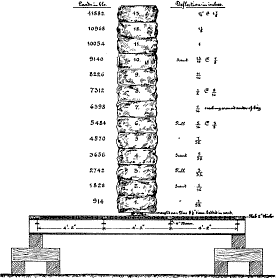
FIG. 14. MATHEMATICAL DETAILS OF FIG. 13
|
| LOAD TEST. |
The method of testing the slab
illustrated by Figs. 13 and 14 was to place a steel disc eight and
one-half inches in diameter in the center of the middle panel, and to
load this disc with rectangular building stones 27×27×12
inches, each weighing about 914 pounds.
|
|
These stones were placed one at a time by means of a derrick, and the
appearance of the final load of thirteen stones is clearly shown by Fig.
13. The weight of the final load was about 11,882 pounds, concentrated
on the disc eight and one-half inches in diameter, or 0.394 square feet
in area.
At 5484 pounds the concrete began to crack,
and this cracking continued until the load reached 9140 pounds, when
the lenses began to crack. The breaking continued until, at 11,882
pounds, crushing and general clipping of the concrete and glass took
place. After the removal of the load the slab returned to a permanent
deflection of one and one-quarter inches. While, as a result of the
final load, the concrete and lenses were crushed, the twisted rods
were not broken, and the slab continued to support its load.
|
| IMPACT TEST. |
Following the static load test, one of
impact was conducted. In this a stone weighing 914 pounds was dropped
seventeen feet, and struck on one corner directly over one of the
five-inch beams. The effect of this blow was to deflect the beam
the beam permanently about four inches, to pierce a 9×12 inch
hub through the slab, and bend but not break the steel rods, and to
break about twenty lenses. The same stone was then dropped from a
height of nineteen feet and four inches, striking on its end in the
middle of one end panel. The effect of the blow was to smash a
large hole through the concrete and to bend the steel rods, but not
to penetrate through the slab. The purpose of the impact tests was
to demonstrate he effect on the vault lights of heavy objects falling
from a second-story window of a building.
|

FIG. 15. LUXFER PRISM No. 60
For Steel-Concrete Setting, with which
light may be diffused in basements.
|
|