WHAT HAPPENS WHEN
A SUSPENSION INSULATOR
IS HIT WITH A STONE OR RIFLE BULLET?
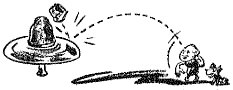
Below a certain energy limit, depending on many
factors, nothing happens. Just above that limit
the glass, or the glaze, chips off or "spalls."
Considerably above that limit any insulator, glass
or otherwise, will break. Here, the physical
differences between the two commercially important
materials are very noticeable. One or more pieces
of the skirt usually fall out of type No. 2 insulators
-- otherwise, they may seem sound. But often the
original cracks slowly extend into the head, during
an indeterminate period of time, and cause electrical
failure.
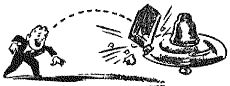 No visual observation will reveal the fault -- only
by buzz stick and high voltage flashover (and
sometimes not then) can it be found. This is a
maintenance item of appreciable magnitude. In the
laboratory a 10,000 volt neon transformer, with
voltage between cap and pin, will detect and
amazing number of electrical failures in insulators
which seem to be essentially sound.
No visual observation will reveal the fault -- only
by buzz stick and high voltage flashover (and
sometimes not then) can it be found. This is a
maintenance item of appreciable magnitude. In the
laboratory a 10,000 volt neon transformer, with
voltage between cap and pin, will detect and
amazing number of electrical failures in insulators
which seem to be essentially sound.
|
![Bad Man Shooting Pyrex Suspension Unit with Rifle [oh, he'll pay alright]](bang.gif "Bad Man Shooting Pyrex Suspension Unit with Rifle [oh, he'll pay alright]")
PYREX suspension insulators are self-indicating.
They resist impact stresses stoutly, but if a deep
crack penetrates into the tension zone the stresses
are no longer balanced and the insulator quickly
drops the skirt which breaks into many pieces.
The patrolman has no difficulty in seeing the
broken unit. The cracks extend into the head but
the head remains in place and will not drop the
line because it is encased in metal. Strings of
these broken "hub" sections have repeatedly been
tested under an 8,000 lb. load while vibrating
at 15 to 20 cycles per minutes for hundreds of
thousands of cycles and none has ever failed.
In a standard M and E test the strength of these
"hub" sections exceeds the rated strength of the
complete insulator.
WHAT HAPPENS IN A
"LIGHTNING SURGE" TEST?
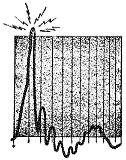
Many PYREX units have been flashed-over 1,000 times,
at 2,000,000 volts, with the steepest available
front surge, without puncturing a single insulator.
The great majority of competitive units would fail
in this test.
|

