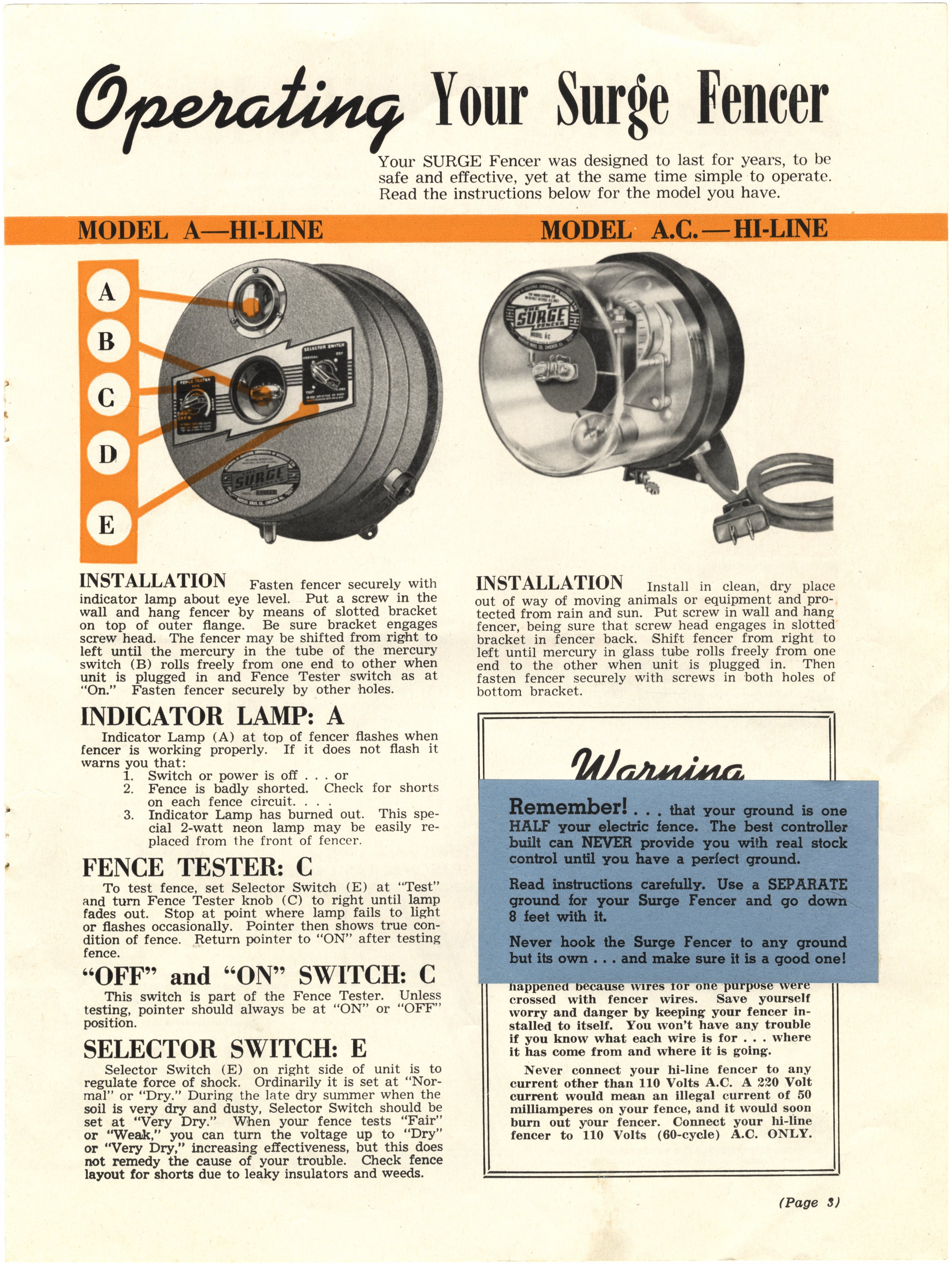
INSTALLATION Fasten fencer securely
with indicator lamp about eye level. Put a screw in
the wall and hang fencer by means of slotted bracket
on top of outer flange. Be sure bracket engages screw
head. The fencer may be shifted from right to left
until the mercury in the tube of the mercury switch
(B) rolls freely from one end to the other when unit
is plugged in and Fence Tester switch is at "On".
Fasten fencer securely by other holes.
INDICATOR LAMP: A
Indicator lamp (A) at top of fencer flashes when fencer
is working properly. If it does not flash it warns
you that:
1. Switch or power is off... orA
2. Fence is badly shorted. Check for shorts
on each fence circuit...
3. Indicator Lamp has burned out. This special
2-watt neon lamp may be easily replaced from
the front of fencer.
FENCE TESTER: C
To test fence set Selector Switch (E) at "Test" and
turn Fence Tester knob (C) to right until lamp fades
out. Stop at point where lamp fails to light or
flashes occasionally. Pointer then shows true
condition of fence. Return pointer to "ON" after
testing fence.
"OFF" and "ON" SWITCH: C
This switch is part of the Fence Tester. Unless
testing, pointer should always be at "ON" or "OFF"
position.
SELECTOR SWITCH: E
Selector Switch (E) on right side of unit is to
regulate force of shock. Ordinarily it is set at
"Normal" or "Dry." During the late dry summer when
the soil is very dry and dusty, Selector Switch
should be set at "Very Dry." When your fence tests
"Fair" or "Weak," you can turn the voltage up to
"Dry" or "Very Dry," increasing effectiveness, but
this does not remedy the cause of your trouble.
Check fence layout for shorts due to leaky insulators
or weeds.
|
INSTALLATION Install in clean, dry
place out of way of moving animals or equipment and
protected from rain and sun. Put screw in wall and
hang fencer, being sure that screw head engages in
slotted bracket in fencer back. Shift fencer from
right to left until mercury in glass tube rolls
freely from one end to the other when unit is plugged
in. Then fasten fencer securely with screws in both
holes of bottom bracket.
Warning
|
Remember!... that your ground is one HALF of your
electric fence. The best controller built can NEVER provide you with
real stock control until you have a perfect ground.
Read instructions carefully.
Use a SEPARATE ground for your Surge Fencer and go down 8 feet with
it.
Never hook the Surge Fencer to any
ground but its own... and make sure it is a good one!
|
Some accidents in electrical fencing
have happened because wires for one purpose were crossed with fencer
wires. Save yourself worry and danger by keeping your fencer installed to
itself. You won't have any trouble if you know what each wire is for...
where it has come from and where it is going.
Never connect your hi-line fencer to
any current other than 110 Volts A.C. A 220 Volt current would
mean an illegal current of 50 milliamperes on your fence, and it would
soon burn out your fencer. Connect your hi-line fencer to 110 Volts
(60-Cycle) A.C. ONLY.
|