A Good Electric Fence Is Easy to Build
You won't find many chores that are easier than setting
up an electric fence. Instead of digging deep postholes and lugging
heavy posts around, you simply drive light stakes or steel posts into
the ground. Instead of grunting under the load of a big bale of wire,
you carry only one roll of wire.
We don't say, do a shoddy job of
fencing, but we do say that a good electric fence is much simpler and
easier to build than ordinary fence.

LINE FENCING
In some states an electric fence
cannot be used as a line fence, but in others, it can be and is used
widely. Many of our users report that the SURGE Fencer is a great help in
keeping their cows away from the neighbor's. It kept our Range free herd
off the line fence and away from the neighbors' cattle.
The most popular form of line fence
with SURGE users seems to be the added SURGE wire to the permanent plain
fence. Where the electric fence is used by itself on the property line,
both regular posts and steel posts are being used.
TEMPORARY FENCING

Your greatest use of the SURGE
Fencer will probably come with temporary fencing. Pasture management
and rotation call for fences that can be set up quickly... and torn down
just as quickly after a short period of use.
How long it will take to set up a
fence depends on each farm and each farmer. Carl R. Price of Onalaska,
Wisconsin, says, I can put up 80 rods of fence in about one and half
hours. That includes unrolling the wire, driving the posts, putting
one brace on each end, stretching and fastening wire.
On every farm it's a quick matter
to move temporary fencing. You simply detach the wires from the
post insulators, pile them on a wagon or truck and move to the new
location. Set your posts in as you drive along, and then go back and
attach the wires to the insulators. Connect it with a fence that's
already in operation, and you're ready to turn your stock into your
new enclosure.
It's each to divide pasture with a
SURGE Fencer. Single wires for each fence will keep stock just where
you want them. When feeding in one section is eaten down far enough,
you turn your cows, for instance, into a different section, giving the
previous one a chance to grow again.
PROTECTION FOR PERMANENT FENCING
Any fence is improved by the
addition of a charged wire, according to Earl B. Armstrong, Franklin,
New York. He has added a SURGE wire to his old style fences for the
added protection it gives.
Build the toughest, most expensive
fence you can get, and somehow, sooner or later, it has to be repaired.
Hogs root under it, or horses reach over it, or breachy cows bother it
until finally it gives away.
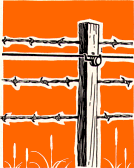
It doesn't take you very long to
take a bagful of insulators and a roll of wire and put up a SURGE Fencer
wire on the inside of each post. Keeping your stock away from your old
fences will pay in both time and money.
|