Up: Glassmaking

Sheet of Glass
17 of 23
|
|
| |
is used as for the old teeming process. The overhead crane carrying what
is known as a goose-neck, takes up and drags out the red hot pot, which is
taken away on a truck and put in the teeming crane, which empties the pot
behind the casting rollers.
Figure 5 shows the pot being
teemed, the glass sheet flowing down an incline and being taken up by the
travelling tables. Down comes the guillotine and the irregular front end
of the plate has been cut off. Down comes the guillotine again and the
sheet is made. The table carrying the glass travels forward in front of
the lehr and a stowing machine pushes the plate into the first kiln. The
plate then travels down the lehr and emerges ready to be cut on the cutting
tables at the cold end.
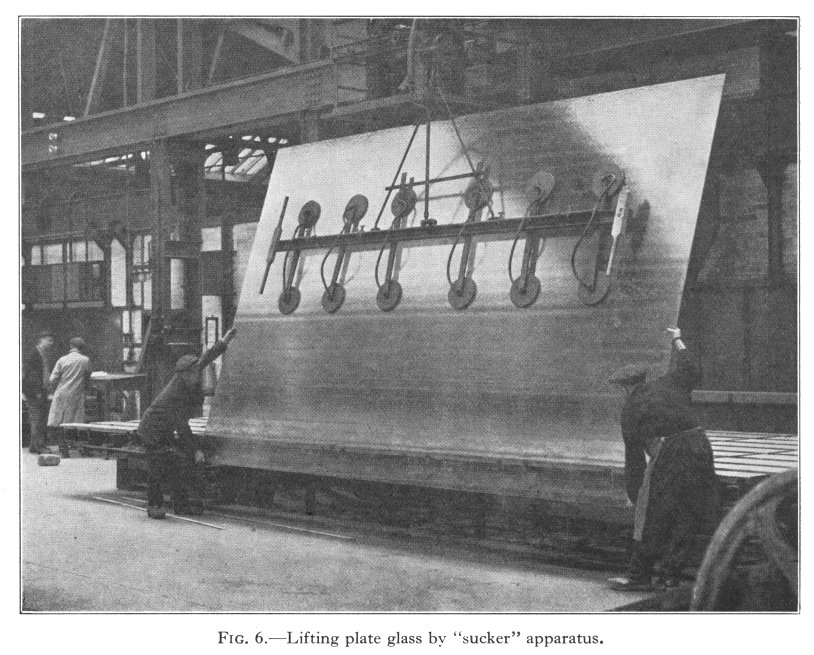
The plate, when cut, is lifted up by means of an
apparatus known as a "sucker" (Figure 6), which transfers
it to a travelling carriage, by which it is carried to the grinding shed.
The great advantage of this over the table process is that a much smoother
and flatter sheet is obtained and consequently there is less loss of time
and material in the grinding operation.
CONTINUOUS CASTING
PROCESS. The most modern process of all is one which we are
now using in addition to the Bicheroux and which owes its origin to one of
Mr. Henry Ford's staff. By this process the glass is melted in tanks which
may contain as much as 600 tons and which are somewhat similar in design to
the sheet glass tanks. The apparatus occupies a space of about 500 feet in
length. The molten glass is discharged in the form of a stream between two
forming rolls from which it issues in the form of a continuous sheet or
|
|