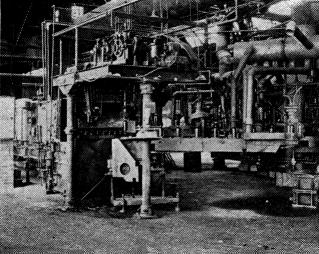
Automatic fingers pick the finished bottles
off the conveyor and place them in exact positions in
the lehr. The complicated overhead machinery accounts
for the exact spacing in the lehr which stretches away
toward the left.
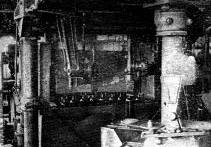
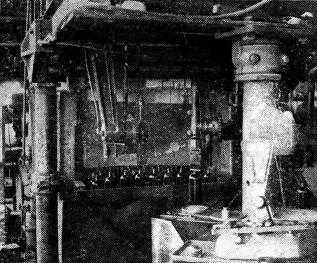
These steel fingers (close-up of above) space
the bottles in the lehr. Accurate spacing means
accurate cooling. Bottles pass through the lehr in
about three hours.
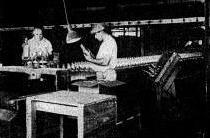
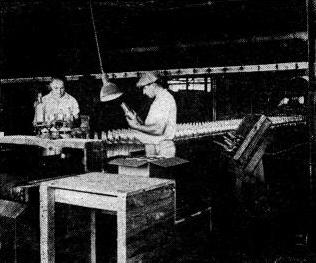
Then as the bottles leave the lehr they are
closely inspected and packed by experts. The bottle
on the scale is to test the weight.
|
THE next time you are in the country, look at a
telephone or electric power pole, and you will see a number
of glass forms fastened to the arms and to which wires are
attached. These are insulators, probably made by Whitall
Tatum Company, for this company has been prominent in the
development and production of these very useful and essential
aids to wire transmission.
Insulators are made on completely automatic machines, except
that they are pressed only and not pressed and blown, as with
bottles. The operation calls for a set of moulds where a
thread is pressed inside. Again, automatic hands remove the
fully formed insulator and place it on a conveyor, whence it
travels through the lehr, is annealed, cooled, and delivered
to be packed and shipped.
The lehr performs a very important function in the manufacture
of glass bottles. Bottles are put into the lehr at a temperature
of from 1050 to 1075 degrees Fahrenheit, and before they had
time to set up strains from uneven cooling. In the lehr, they
are cooled so gradually and evenly that no strains are present
in the finished product, which is taken out at room temperature.
Before the mechanical lehr was invented box-like ovens of fire
brick were used. When these were heated to the proper temperature,
they were filled with bottles and sealed. They then cooled
gradually and gave the proper annealing in three days, as compared
with two over three hours now required.
At the cold end of the lehr, each bottle is examined thoroughly
for common defects such as marks, shrends (fine cracks), blisters,
and splits. The sorter must weigh the bottles every so often to
see that they are of the proper weight, and he must make sure as
well that each bottle is the right shape and is fully blown. Any
of these faults would make the bottle unfit for commercial use.
There is also a laboratory in which tests are made throughout
twenty-four hours.
|