|
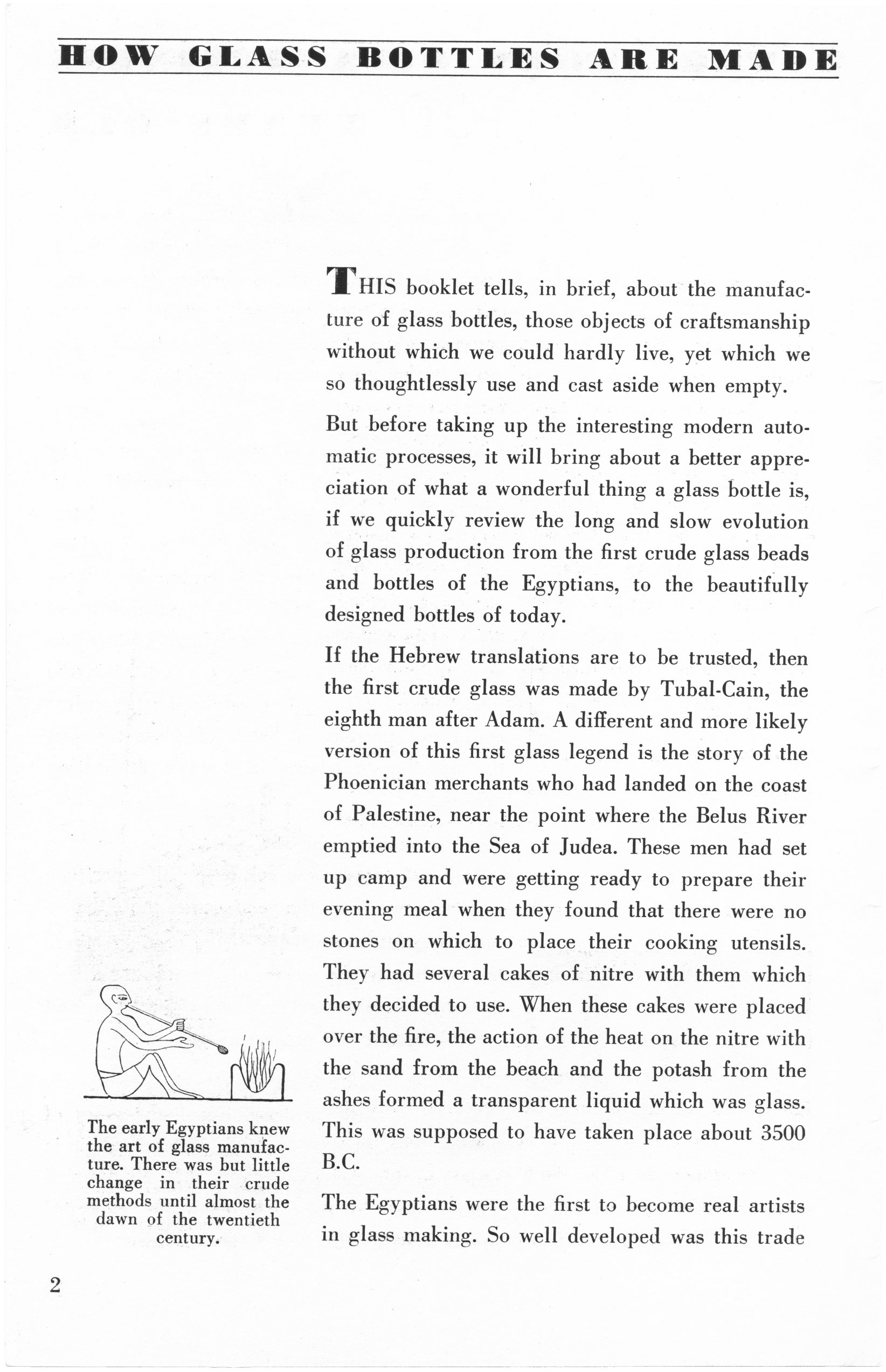
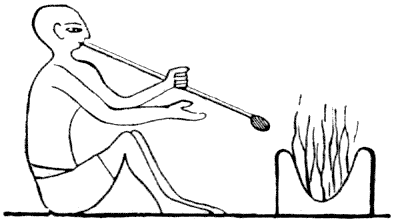
The early Egyptians knew the art of glass manufacture.
There was but little change in their crude methods until
almost the dawn of the twentieth century. |
|
THIS booklet tells, in brief, about the
manufacture of glass bottles, those objects of craftsmanship without
which we could hardly live, yet which we so thoughtlessly use and cast
aside when empty.
But before taking up the interesting modern automatic processes, it
will bring about a better appreciation of what a wonderful thing a
glass bottle is, if we quickly review the long and slow evolution
of glass production from the first crude glass beads and bottles
of the Egyptians, to the beautifully designed bottles of today.
If the Hebrew translations are to be trusted, then the first crude
glass was made by Tubal-Cain, the eighth man after Adam. A different
and more likely version of this first glass legend is the story
of the Phoenician merchants who had landed on the coast of
Palestine, near the point where the Belus river emptied into the
Sea of Judea. These men had set up camp and were getting ready to
prepare their evening meal when they found that there were no
stones on which to place their cooking utensils. They had several
cakes of nitre with them which they decided to use. When these
cakes were placed over the fire, the action of the heat on the nitre
with the sand from the beach and the potash from the ashes formed
a transparent liquid which was glass. This was supposed to have
taken place about 3500 B.C.
The Egyptians were the first to become real artists in glass
making. So well developed was this trade
|