Up: 3-Way Prism

Catalog 14-S
16 of 18
|
|
| |
|
3-Way Patented Expansion Joint
|
The big problem in sidewalk
construction of all kinds is that of providing for the
expansion of the mass and at the same time of having the
joints water tight. Experiment after experiment has
been tried and until the perfection of the 3-Way
Expansion Joint every one failed in some vital way. One
would be too open and require packing with oakum and
compound, but in summer this would soften and squeeze
out, leaving a leaky seam; another would be too close
and the expansion would crack either the glass or the
cement, and thus start a leak.
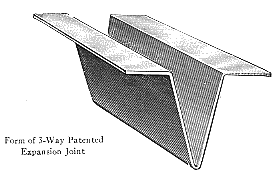
The 3-Way patented Expansion
Joint is the only one that is always weather proof and
at the same time allows for the pressure due to expansion.
Any sheet metal, preferably zinc or copper, is drawn in
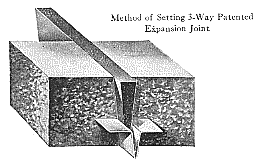
the form of a V with broad flanges. As shown, the 3-WAY
joint is placed between section of Paschall construction
or Simplex preformed slabs at right angles to building,
then the concrete is worked in, embedding the two flanges
of the metal in the cement mass. This V-shaped gutter or
trough is absolutely water right and it closes and spreads
as the walk expands and contracts.
|
Joints made in this way will
remain water tight. Expansion joints in floors, roofs
and skylights can all be successfully fitted with the
3-WAY patented Expansion Joint. We can furnish the
3-WAY Expansion Joint to those who wish to use it in
this way at a moderate price.
Special Note: While we
will supply this joint to those who want it, we must call
attention to the fact that the 3-WAY Expansion Joint
is fully covered with patents and any infringers will be
prosecuted.
Caulking Compound
Our Caulking Compound is the
result of years of study and experiment to make a compound
that would be water-proof and at the same time would
remain plastic and soft but not sticky. We can and do
guarantee 3-WAY Caulking Compound to fill all these
demands.
Sold in 1 and 2-gallon cans and
in bulk to those contractors who wish to make their work
permanently satisfactory.
|
These expansion joints should be
placed at intervals of four feet or less and should be
at right angles to the building. Any regular cement
contractor should be able to set this work, following
the directions we supply.
"Make expansion joint first,
placing 3-WAY Expansion Joint in position where joint
is desired, then insert wedge shaped wooden strip in
the joint to the level of the finish surface, as in
Fig 15. Leave in position while cementing and allow
to remain till cement is sufficiently set so as to loosen
up the strip without cracking the cement,--and after the
cement is thoroughly set, remove and fill the opening
with 3-WAY Caulking Compound, poured in hot."
|
 |
|