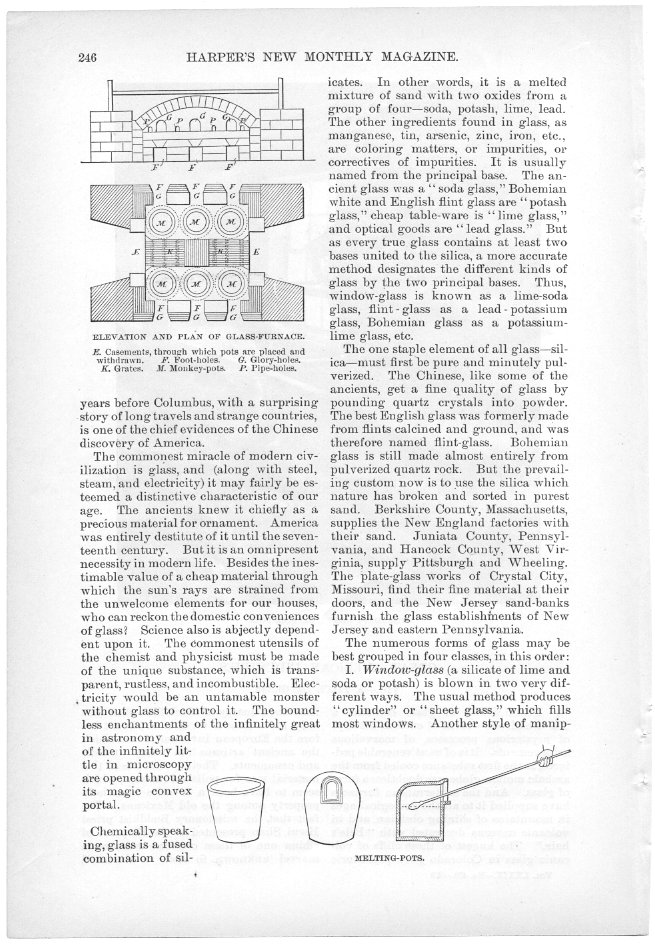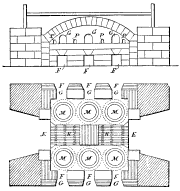
ELEVATION AND PLAN OF GLASS-FURNACE.
E. Casements, through which pots are placed
and withdrawn. F. Foot-holes. G. Glory-holes.
K. Grates. M. Monkey-pots. P. Pipe-holes.
years before Columbus, with a surprising story of long travels and
strange countries, is one of the chief evidences of the Chinese
discovery of America.
The commonest miracle of modern civilization
is glass, and (along with steel, steam, and electricity) it may
fairly be esteemed a distinctive characteristic of our age. The
ancients knew it chiefly as a precious material for ornament.
America was entirely destitute of it until the seventeenth century.
But it is an omnipresent necessity in modern life. Besides the
inestimable value of a cheap material through which the sun's rays
are strained from the unwelcome elements for our houses, who can
reckon the domestic conveniences of glass? Science also is abjectly
dependent upon it. The commonest utensils of the chemist and
physicist must be made of the unique substance, which is transparent,
rustless, and incombustible. Electricity would be an untamable monster
without glass to control it. The boundless enchantments of the infinitely
great in astronomy and of the infinitely little in microscopy are opened
through its magic convex portal.
Chemically speaking, glass is a fused combination of silicates. In other
words, it is a melted mixture of sand with two oxides from a group of
four--soda, potash, lime, lead.
|
The other ingredients found in
glass, as manganese, tin, arsenic, zinc, iron, etc., are coloring matters,
or impurities, or correctives of impurities. It is usually named from
the principal base. The ancient glass was a "soda glass," Bohemian white
and English flint glass are "potash glass," cheap table-ware is "lime
glass," and optical goods are "lead glass." But as every true glass
contains at least two bases united to the silica, a more accurate method
designates the different kinds of glass by the two principal bases. Thus,
window-glass is known as a lime-soda glass, flint-glass as a lead-potassium
glass, Bohemian glass as a potassium-lime glass, etc.
The one staple element of all glass-- silica--
must first be pure and minutely pulverized. The Chinese, like some of the
ancients, get a fine quality of glass by pounding quartz crystals into powder.
The best English glass was formerly made from flints calcined and ground,
and was therefore named flint-glass. Bohemian glass is still made almost
entirely from pulverized quartz rock. But the prevailing custom now is to
use the silica which nature has broken and sorted in purest sand. Berkshire
County, Massachusetts, supplies the New England factories with their sand.
Juniata County, Pennsylvania, and Hancock County, West Virginia, supply
Pittsburgh and Wheeling. The plate-glass works of Crystal City, Missouri,
find their fine material at their doors, and the New Jersey sand-banks
furnish the glass establishments of New Jersey and eastern Pennsylvania.
The numerous forms of glass may be best grouped in
four classes, in this order:
I. Window-glass (a silicate of lime and
soda or potash) is blown in two very different ways. The usual method
produces "cylinder" or "sheet glass," which fills most windows. Another
style of manipulation

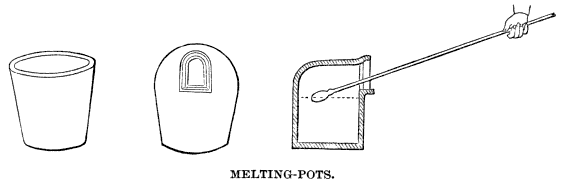
MELTING-POTS.
|