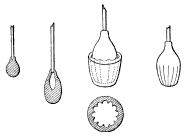
GLASS BLOWN INTO MOULD.
new-comers. Another boy finishes the bottles by holding the ragged necks
into the furnace to be rounded evenly, and carries them to the annealing
"leer." A very dextrous man is able to blow 400 dozen small bottles a
day. Most of the manifold forms of glass are formed in analogous processes
by the blower's breath, not only bottles, but decanters, goblets, pitchers.
These, however, are all cheaper grades, as the moulds prevent the
peculiar polish which comes from working in the air.
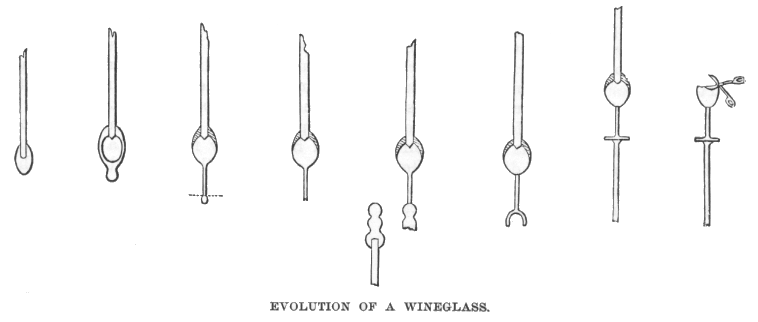
Let us watch another workman who is rolling on a
marver his freshly gathered lump of soft glass. A little puff of air
blows it into a bulb which he swings out into longer shape. From this he
is going to make a goblet, though he might as easily produce from it a
pitcher, a bottle, or a chimney. The bulb is swelled out to the size
desired for the bowl. He attaches a small red lump to the bottom of the
bowl and draws it out into a stem. Another man has cast a bell-shaped
piece, and this is fastened to the stem for the base of the goblet,
then flattened into proper shape in a mould.
|
The blow-pipe is detached from the upper half of the bowl, which
is trimmed by shears. Finally the end is rounded in the furnace. The more
expensive goblet has the stem drawn out from the original bulb and the base
blown separately like a tiny disk of crown-glass. A pitcher has its body
formed first, either by being blown into a mould or slowly developed from a
bud by patient fingers. The handle is added separately as a lump attached
to one end, then drawn out to the desired length, cut off, and attached.
All the tools are extremely simple, demanding great cleverness of handling.
The most entrancing corner of a flint-glass
establishment is the part where colored glass is worked into some of its
myriad combinations. Many flint-glass furnaces have several different
colors of glass melted continually alongside of the transparent staple
to supply material for fancy wares. To describe all the beautiful
combinations of color and form and their method of growth would be
impossible. Frequently two or three layers of different color are combined,
as if cemented together, making a basis for cameo engraving or fancy
manipulation. This is done by dipping successively into the different
pots, skilfully distributing each extra color evenly over the central one,
and then blowing them all as one into the desired shape. The decorative gas
globes with knobs or fancy patterns in a single color of glass are made
by blowing the bulb into a mould which gives the ornamental form, and then
finishing the two openings by hand. The interlacing of colored stripes
requires a machine which
|