in the judgment of architects against that portion of the American product
it supplants.
In all the branches of this work the advantages
of gaseous fuel are an important element. The old glass made by coal was
much inferior to the gas-made product, being coated with smoke and a white
deposit of sulphur which could not be wholly cleansed. But gas produces
a surface brilliant and clear, and by the employment of this fuel American
glass-makers have in the
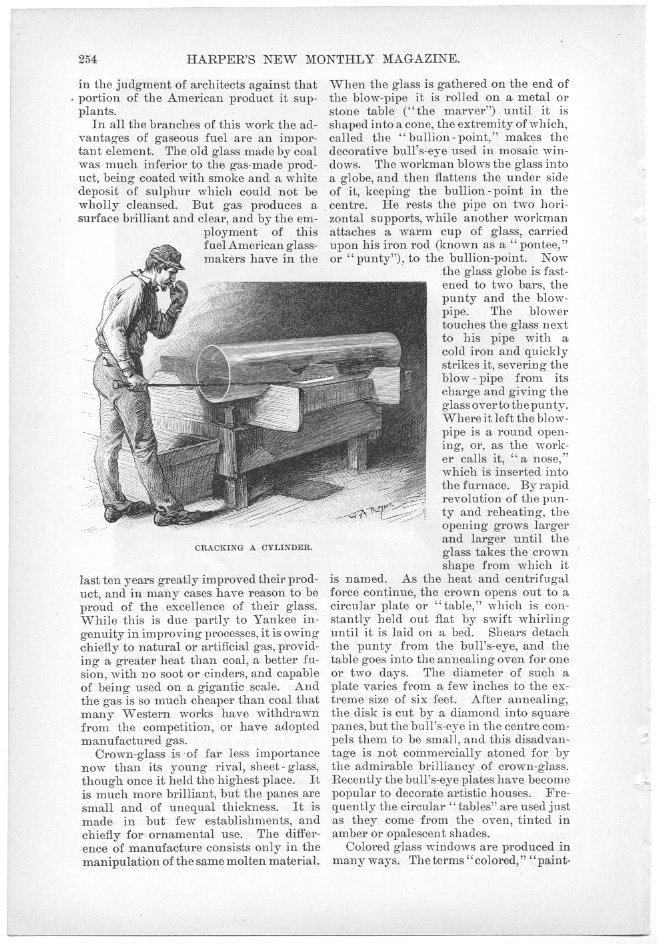
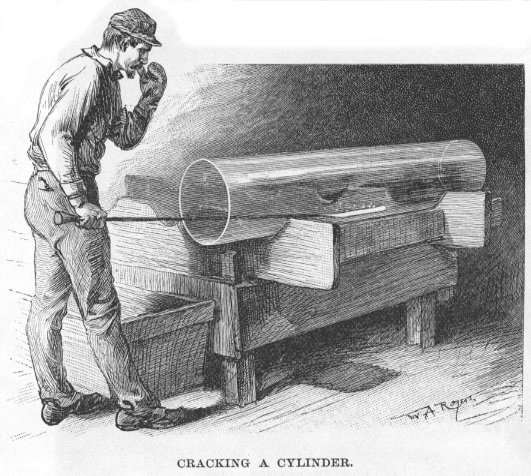
CRACKING A CYLINDER.
|
last ten years greatly improved their product, and in many cases have
reason to be proud of the excellence of their glass. While this is due
partly to Yankee ingenuity in improving processes, it is owing chiefly
to natural or artificial gas, providing a greater heat than coal, a better
fusion, with no soot or cinders, and capable of being used on a gigantic
scale. And the gas is so much cheaper than coal that many Western works
have withdrawn from the competition, or have adopted manufactured gas.
Crown-glass is of far less importance now than its
young rival, sheet-glass, though once it held the highest place. It is
much more brilliant, but the planes are small and of unequal thickness.
It is made in but few establishments, and chiefly for ornamental use.
|
The difference of manufacture consists only in the manipulation of the
same molten material.
When the glass is gathered on the end of the blow-pipe it is rolled on a
metal or stone table ("the marver") until it is shaped into a cone, the
extremity of which, called the "bullion-point," makes the decorative
bull's-eye used in mosaic windows. The workman blows the glass into a
globe, and then flattens the under side of it, keeping the bullion-point
in the centre. He rests the pipe on two horizontal supports, while another
workman attaches a warm cup of glass, carried upon his iron rod (known as
a "pontee," or "punty"), to the bullion-point. Now the glass globe is
fastened to two bars, the punty and the blow-pipe. The blower touches the
glass next to his pipe with a cold iron and quickly strikes it, severing
the blow-pipe from its charge and giving the glass over to the punty.
Where it left the blow-pipe is a round opening, or, as the worker calls
it, "a nose," which is inserted into the furnace. By rapid revolution
of the punty and reheating, the opening grows larger and larger until the
glass takes the crown shape from which it is named. As the heat and
centrifugal force continue, the crown opens out to a circular plate or
"table," which is constantly held out flat by swift whirling until it is
laid on a bed. Shears detach the punty from the bull's-eye, and the table
goes into the annealing oven for one or two days. The diameter of such a
plate varies from a few inches to the extreme size of six feet. After
annealing, the disk is cut by a diamond into square panes, but the bull's-eye
in the centre compels them to be small, and this disadvantage is not
commercially atoned for by the admirable brilliancy of crown-glass.
Recently the bull's-eye plates have become popular to decorate artistic
houses. Frequently the circular "tables" are used just as they come from
the oven, tinted in amber or opalescent shades.
Colored glass windows are produced in many ways.
The terms "colored," "painted,"
|