Extreme delicacy of judgment is required to bring together precisely the
combinations requisite to produce the artistic effect of landscape, drapery,
and figure, as the entire effect is made without paint or stain except
monochrome shading. Mr. Louis C. Tiffany has brought the art of making
opalescent glass to the highest perfection it has yet attained. A remarkable
illustration of his success is the memorial window for St. Paul's Church,
Milwaukee, Wisconsin-- the largest opalescent window in the world--
reproducing Doré's painting "Christ leaving the Prætorium."
Plate-glass has only recently been attempted in
this country, and there are but four large establishments making it, but
they produce enormous quantities, that compete in quality and price with
the best European grades. The largest plate-glass plant is at Creighton,
twenty miles north of Pittsburgh, and near the famous gas district of
Tarenton. It is marvellously equipped for prodigious results. The glass
is a double silicate of lime and soda, like sheet and crown glass, but
melted in large open kettles, instead of monkey-pots, which are placed
on frames behind fire-clay doors. When the fusion is complete the door
is opened, and a
|
gigantic two-pronged fork, mounted on wheels, enters the furnace, grasping
the kettle by depressions on each side of it. It brings out the glowing
gallons of molten glass to a low truck, which carries it to the casting
table. At Creighton the casting house, containing furnaces, tables, and
annealing ovens, is 65 by 150 feet, four times as large as the famous
St.-Gobelain Halle in France, and nearly twice the size of the British
works at Ravenhead. There are two iron casting tables, seven inches thick,
nineteen feet long, and fourteen feet wide. They run on tracks which
reach every furnace and annealing oven. The table is brought as near as
possible to the furnace, and over it the kettle of melted glass is hoisted
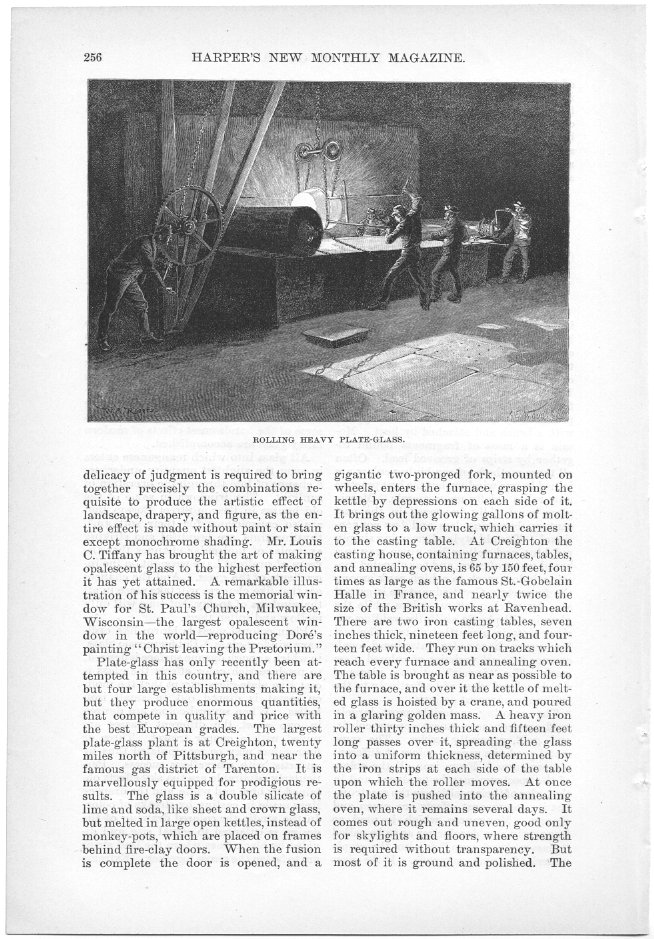
by a crane, and poured in a glaring golden mass. A heavy iron roller thirty
inches thick and fifteen long passes over it, spreading the glass into a
uniform thickness, determined by the iron strips at each side of the table
upon which the roller moves. At once the plate is pushed into the annealing
oven, where it remains several days. It comes out rough and uneven, good
only for skylights and floors, where strength is required without
transparency. But most of it is ground and polished.
|