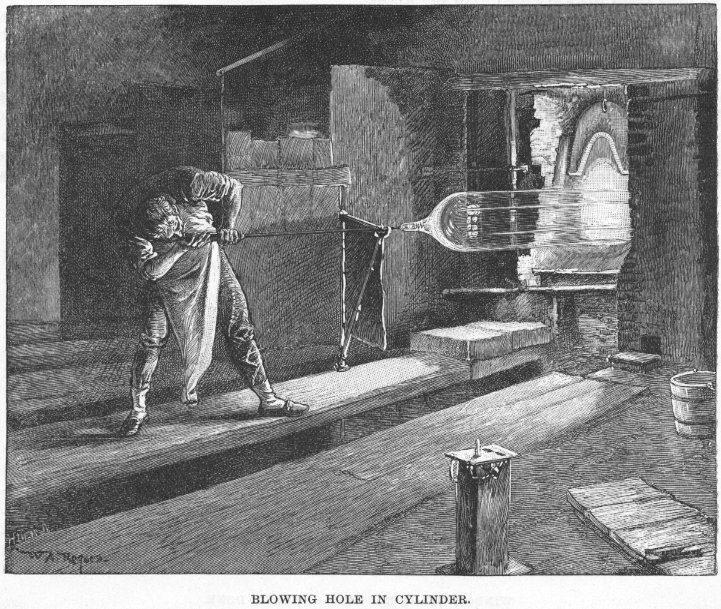
When it stiffens disobediently he rests the pipe on a handy prop, and
softens the refractory end in the furnace. When the glass flows too
freely he tosses the cylinder into the air until it settles together in
proper consistency. Blowing, swinging, and heating, he extends the
bubble to nearly his own length, and the glass becomes a round-tipped
cylinder resembling the hot-water reservoir attached to kitchen ranges.
As the cylinder is a foot in diameter and five
feet long, and the tube is as much longer, the most delicate skill must
be coupled with steady muscle for this work. The blower's work is the
most difficult and profitable part of the entire trade. For large
cylinders furnishing a pane 44 to 77 inches of double thickness the
labor is so severe that few men are equal to it. When the cylinder is
comparatively cool the blower holds the end in the furnace, blows into
the pipe, and quickly covers the mouth-piece with his hand. A slight
report follows. The end has softened with the heat, and the expanding
air within has blown an escape through the glass.
|
Still keeping the glass in the furnace, he revolves it until the
centrifugal force extends the hole larger and larger, and at last to the
size of the cylinder. Now he removes it from the furnace, and suspends
it in the pit until the soft edge cools to a cherry red. Then an assistant
carries it off, and the blower's work is done. After a moment's rest he
receives another pipe with an embryo cylinder in the form of a plastic mass,
and repeats the same process for ten hours.
When the cylinder is finished and placed on the
"horse," the pipe is detached from it by touching the neck with a cold
iron. To cut off the remaining portion of the neck the cylinder is
encircled by a thread of hot glass and touched with a cold iron, after
which it is cracked open lengthwise by passing a red-hot iron along its
inner surface.
It is next taken to be flattened. The flattening
oven has a turn-table carrying four stones about 40 by 80 inches, made of
fire-clay. After a preliminary warming the flattener places the cylinder
upon the stone before him, and as soon as it is sufficiently
|