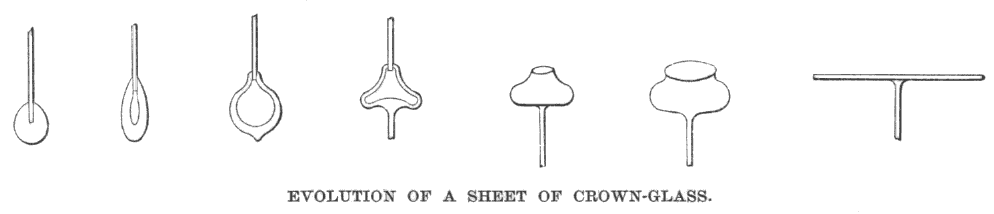
"stained," and "mosaic," are commonly used synonymously, but they refer
to very different processes. Plain colored glass has neither paint nor
stain, being dyed in the pot. Flashed glass, such as is used for lanterns,
signs, and names of streets in street cars, is made the same as window-glass
except that the clear is coated at the start with a colored layer by being
dipped into a pot of very deep color. This thin envelope is cut through
to the plain glass by the sand-blast or acid to make the lettering in signs.
Painted glass gets its color from enamels fused to the surface. Stained
glass is produced by soluble metal oxides applied with a brush and attached
by heat. Mosaic is a mass of fragments bound together by strips of grooved
lead. Often all these methods of combining colors are joined in one window,
but the best practice now relies chiefly upon mosaic. Mosaic glass has
rapidly improved in the past century, becoming less and less conventional.
The old style of grouping simply red, blue, and yellow has given way to a
broad range of color, and has elevated mosaic window work to a high rank among
the fine arts. Great advantage is gained also by mixing several colors
while the glass is still plastic, skilfully welding various tints in a
mottled plate. The last few years have also introduced opalescence into
all varieties of colored glass work. The "jewels" cut from pieces of a rich
colored glass add effectively to the brilliancy of recent designs.
The coloring materials most largely used are iron,
manganese, copper, cobalt, and gold, generally oxides. The same metal
produces several colors at different temperatures. From iron all the colors
of the spectrum may be produced, and in the order of their position of the
spectrum, but its commonest effects are green and orange. Manganese, which
is used so frequently as a decolorizer as to be called "glass-makers' soap,"
is also the staple material for pink or purple. If the glass
|
containing it is left too long in the furnace it becomes pale brown, then
yellow, and finally green. Copper produces the reds of cheap glass, and
by raising the temperature the result is purple and then blue. Cobalt
gives blue or black. The finest rubies and violets come from gold. One
part of gold will give a full rich color to 1000 parts of glass, and the
color can be modified from amber through a gorgeous series of reds to ruby.
Carbon (powdered cannel-coal) is used for cheap black and amber bottles.
Opalescent ware has many materials for coloring, as tin, arsenic, cryolite.
It is by skilfully using the effect of heat in varying colors that some
of the handsomest effects of modern fancy glass are accomplished.
All glass into which manganese enters in even the
slightest quantity undergoes a change of hue through the operation of
sunlight. The windows in some of the old houses in Beacon Street, Boston,
that are so conspicuous for their soft amethystine tints, are beautiful
and striking examples of molecular changes that the years of sunlight have
wrought on the ingredients of the glass. And the chances are that like
changes will take place in all the windows of to-day, but time will only
mellow and soften them.
Plain colored glass is blown like ordinary
window-glass. But for mosaic glass, in which a rough opaque surface is
desired, to produce rich color effects the glass is cast, like plate-glass,
except that the molten metal is dipped out in small iron ladles. When
several colors are desired in one sheet, the different masses are mixed
with a copper trowel. Three or four colors may be manipulated thus by an
artist with marvellous success. Particularly admirable are the sky
effects obtained by blue and white, and the drapery lines made in casting
by streaks of color. In the studio the colored drawing of the design is
enlarged to actual size, and divided by black lines where the lead strips
are to fasten the pieces together.
|