of a pot stops everything for a day until the pot is removed, another built
into its place, and its contents fused. These difficulties, and also the
annoyance of sulphur and soot from coal fuel, are entirely removed by the
"tank furnaces" heated by gas, which are remodelling glass-making. The
original and staple tank furnace bears the name of its inventor, Siemens,
and is heated from the sides by his well-known regenerative gas system. In
place of the melting-pots there is a tank made of the same material as the
pots, in blocks, which occupies the whole bed of the furnace, and is
divided into three compartments separated by floating partitions. At the
rear side of the furnace is the melting compartment, which is fed with
frequent charges of raw material. As this melts it sinks to the bottom,
and through an opening at the base of the partition passes to the refining
compartment. Here it finds a higher temperature, and as it becomes purified
it flows out below the next partition to the gathering compartment. This
last is exposed to a lower heat than the other two, and permits the melted
glass to thicken for the blower's use. The floating partitions are dispensed
with in a later improvement, in which refining vessels float upon the sea
of glass and gather the molten material from the lowest depth, raising it to
the surface to be refined in another compartment, whence it flows to the
working-out compartment.
The working furnaces, of which there are several
to every melting furnace, are small blast-furnaces, usually heated in this
country by benzine, each providing a number of openings directly into the
flames. A spectator sees at once the appropriateness of their name--
"glory-holes." In these the workman resoftens the glass as he completes
the various small objects.
The annealing oven is a long, low, rectangular
chamber through which the finished products slowly pass in shallow trays
from an intense heat to the ordinary temperature. At one end of it the red
and blue flames dash into their reception-room above the objects which are
entered there for tempering, lining the roof with long trails of fire, and
hastening through the course that leads them to the tall chimney. At the
other end the products of the factory are removed into the cool air.
For window-glass the raw material or "batch"
contains 30 to 36 per cent. of raw limestone, 35 to 42 per cent. of
sulphate of
|
soda, 1½ to 2½ per cent. pulverized charcoal, to each 100
parts of sand. These are thoroughly ground and mixed together. The
relative amounts of the ingredients are alike in no two establishments.
When the furnace has been brought to the proper
temperature the pots are filled with the mixture, and as soon as this is
melted down, depending on the size of the pots and the heat of the furnace,
a second filling is put in, and lastly a third, which generally fills the
pot; in case it does not, a few shovelfuls of broken glass called "cullet"
are added. The entire melting requires about sixteen hours, and is
carefully watched by the master melter, who urges the furnaces to their
utmost intensity, and is on the alert for the signs which indicate when
the metal is ready. The heat is then lowered to make the glass less fluid,
and now the workmen begin their wonders.
They are a muscular set, and the hot surroundings
compel them to dispense with all superfluous clothing. Each workman is
trained to one small part of the process, and does nothing else. In making
a pane of window-glass, for instance, the labor is divided among for men,
the gatherer, the blower, the flattener, and the cutter. The gatherer
puts between his teeth the wooden plug by which he holds in position a
rough mask to screen his face from the furnace. Then he seizes the blow-pipe,
a simple wrought-iron tube flared on one end, and starts the "journey," as
the working of the glass is called.
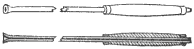
BLOW-PIPE.
|
He dips the flared end of the pipe into the pot, and turning it carefully,
covers it with glass. When it is slightly cooled he repeats the operation,
and then shapes the metal into a symmetrical oval in a mould. He again dips
the pipe into the metal, when enough adheres to that already on the pipe
for a cylinder of the ordinary dimensions. When the glass is to be of double
thickness, the metal must be gathered four or five times, and weights from
thirty to forty pounds. The final dip requires the greatest skill, for the
plastic ball must be got into a homogeneous and symmetrical shape before
it leaves the furnace. This the gatherer accomplishes by resting his pipe
on a convenient fulcrum and rapidly revolving
|