cut in the mould. The sharp broken mouth is then rounded in the "glory-hole,"
and the bottle goes to the annealing chamber.
Flint-glass is the general term for all the
multiform utensils and ornaments (apart from windows and dark bottles)
which make glass an omnipresent blessing in modern life. The distinctive
peculiarity of flint-glass is the presence in it of lead, which imparts
a brilliancy unlike that of most other glass. The lack-lustre surface of
all the old objects of glass made before the English invention of a lead
formula is noticeable. Lead oxide was originally used only in most
expensive glass prepared from calcined flints. But gradually it has crept
into many grades, down to the most common material for household and fancy
wares and for all transparent bottles, giving them all a finer lustre than
was otherwise obtained until the recent invention of lime glass. And the
costliest of all glass, that used for optical lenses and imitation gems,
still gains its extraordinary weight and refractive power from lead. The
honors of skill in flint-glass production are broadly divided among the
nations, England taking the lead in the crystal or purest flint glass used
for cutting; Italy (Venice) in colored designs more brilliant than any
made in the days of the republic, when flint-glass was not known; Switzerland
in imitation gems; Germany in cheap vases; France in lens disks; and America
in pressed glass and cheap table-ware. Recently a cheaper flint-glass has
been introduced into American pressed ware, in which lime is substituted for
lead, yet which retains much of the lustre and clearness of lead flint.
Flint-glass is either blown, moulded, or pressed,
and frequently all three methods may be seen together in the same
establishment. A flint-glass factory is a most entertaining medley of marvels.
As you enter the great building that surrounds the huge chimney the first
impression is that you are in a human ant-hill rumbling with inordinate
activity. Or perhaps the sensation is better described as a plunge into
a purgatorial chamber of industrious demons. In the centre the openings
in the gigantic furnace dazzle you like glaring eyes from a soul of fire;
but the glow comes really from molten glass in the dozen "monkey-pots"
about the blaze. Scores of workers, boys, youths,
|
and men, throng in restless confusion. It looks as if every one were
running about on some impish deed of his own fancy. But stand still and
watch closely, and you will see it is all a great system of human clock-work,
each movement fitting nicely into the whole effect. The men at the furnace,
who seemed at first to be devils thrusting pitchforks into the blazing
depths to toast their victims, are only gathering metal on their punties.
When a sufficiently large lump has been collected the man wanders off with
it. You think he will certainly burn some one with that burning ball of
fire, they are all bustling about him so incessantly. But follow him
carefully and you see him silently hand the tube to an older man, who
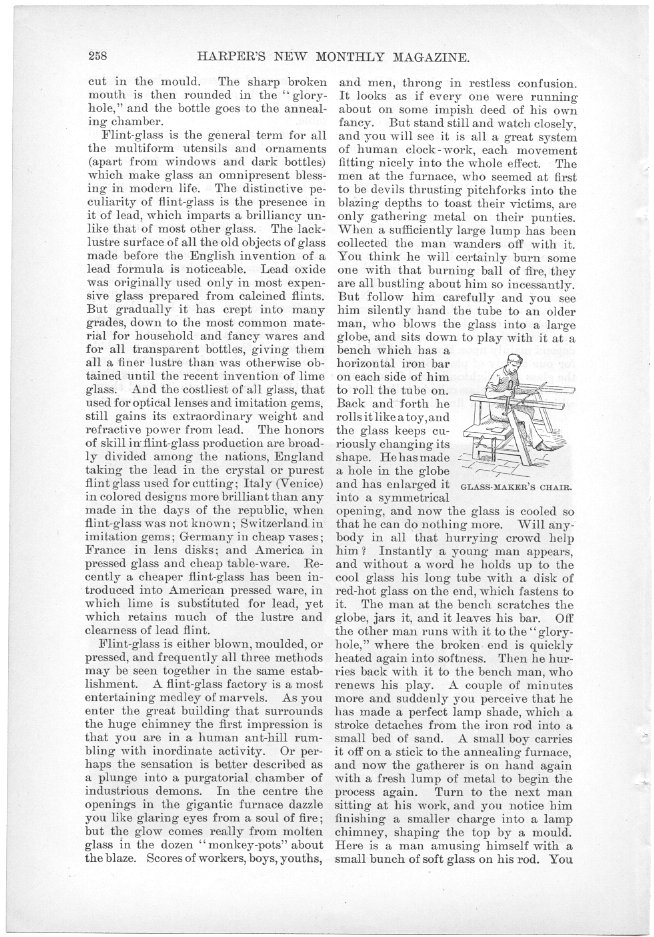
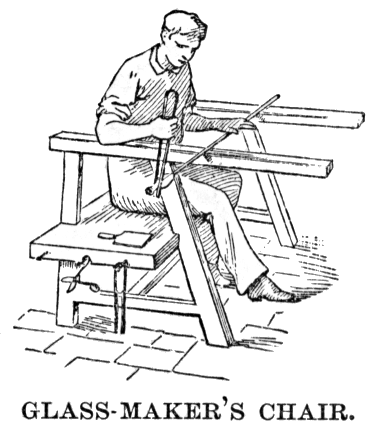
blows the glass into a large globe, and sits down to play with it at a
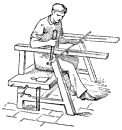
GLASS-MAKER'S CHAIR.
|
bench which has a horizontal iron bar on each side of him to roll the
tube on. Back and forth he rolls it like a toy, and the glass keeps curiously
changing its shape,. He has made a hole in the globe and has enlarged it
into a symmetrical opening, and now the glass is cooled so that he can do
nothing more. Will anybody in all that hurrying crowd help him? Instantly
a young man appears, and without a word he holds up to the cool glass his
long tube with a disk of red-hot glass on the end, which fastens to it. The
man at the bench scratches the globe, jars it, and it leaves his bar. Off
the other man runs with it to the "glory-hole," where the broken end is
quickly heated again into softness. Then he hurries back with it to the
bench man, who renews his play. A couple of minutes more and suddenly you
perceive that he has made a perfect lamp shade, which a stroke detaches
from the iron rod into a small bed of sand. A small boy carries it off on a
stick to the annealing furnace, and now the gatherer is on hand again with
a fresh lump of metal to begin the process again. Turn to the next man
sitting at his work, and you notice him finishing a smaller charge into a
lamp chimney, shaping the top by a mould. Here is a man amusing himself
with a small bunch of soft glass on his rod.
|