|
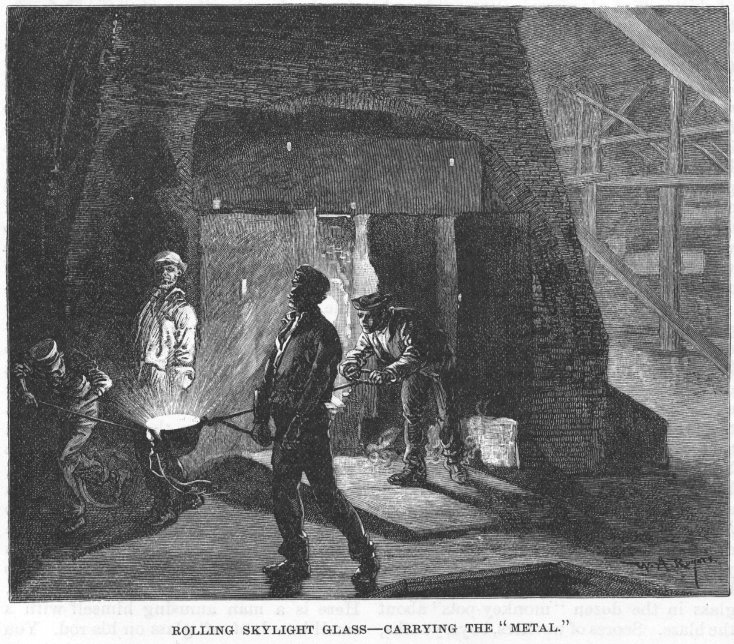
The plates are made fast by plaster of Paris to large rotary platforms,
which revolve so that the entire surface of the glass is covered at each
rotation by the disks of rotary grinding engines. These remove the general
roughness by means of common river sand dredged from the Alleghany.
Three million bushels of sand are used every year for this purpose. Finer
smoothing is effected by emery of different grades, and the last polishing
is done by rouge (calcined sulphate of iron). These operations remove
forty per cent. of the original plate, leaving it from one-fourth to
three-eights of an inch thick. The Creighton works produce 100,000 square
feet of glass every month. Natural gas is the only fuel, taking the place
of 3000 bushels of coal daily. These figures may dispel the mistaken
opinion that we depend mainly upon France and Belgium for our supply of
plate-glass. A part of the glass at Creighton is used for mirrors. The
unpolished glass called "rolled plate," which is fluted in fine lines or
indented
|
in ornamental patterns for obscure lights in door panels, partitions, etc.,
is made by casting the plate-glass upon an engraved table.
Green glass, or "bottle glass," is used only for
the cheaper grades of bottles. The amber glass also used for common
bottles is colored from the same material by the addition of a trifling
quantity of carbon. Fine bottles are made only from flint-glass, but the
green glass work is an important and distinct trade, involving little of
the skill and nicety required by other grades. It is conducted in America
most extensively and successfully near Philadelphia. Much of the sand of
southern New Jersey is sufficiently fine to make excellent bottles. The
bottle-blower's work is quite simple. He gathers the molten glass on a
blow-pipe, puffs a bubble into it, drops the red lump into an iron mould,
which a small boy closes together, and blows the glass into its fixed
shape, with whatever ornament or letter is
|