produces "crown-glass" for more lustrous and expensive glazing. The
latter is no longer made in this country, and is sparingly made in Europe.
II. Plate-glass (the purest silicate of
lime and soda or potash) is cast upon a table and rolled into sheets,
making the richest and largest material for windows and mirrors.
III. Green glass is the coarse "bottle
glass," used chiefly for cheap bottles. It is a crude silicate of lime
and soda, and obtains its green color from the iron present as an impurity
in the sand.
IV. Flint-glass includes the great bulk of
decorative and useful articles both blown and pressed. Its composition
varies with its grade. Its peculiar brilliancy is derived from lead,
which ingredient distinguishes it from all other glass. The true English
flint-glass, which is the same as the French "crystal," is a silicate of
potash and lead. It is very heavy, rings like metal, and is the choicest
material for table and cut ware and optical purposes. When the proportion
of lead is increased it becomes "strass," from which artificial gems are
made. Bohemian glass is a lime glass variety of flint, like American
"crystal glass," from which most of the household goods are made-- dishes,
chimneys, shades, bottles, vases, inkstands, etc.
Each of these four kinds of glass is produced in
a peculiar establishment where generally nothing else is made.
Before we watch the glass magicians at their work
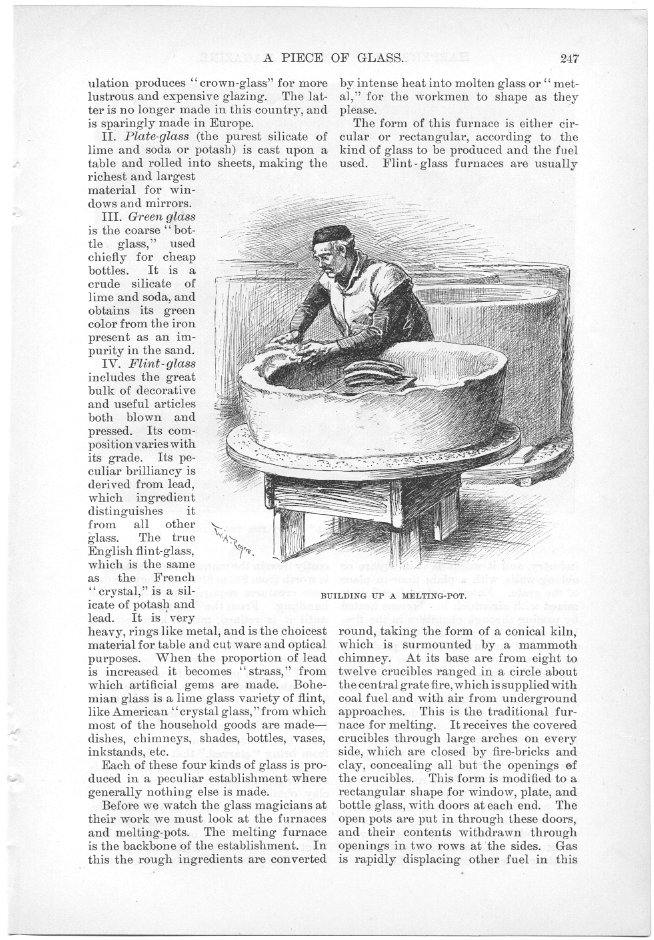
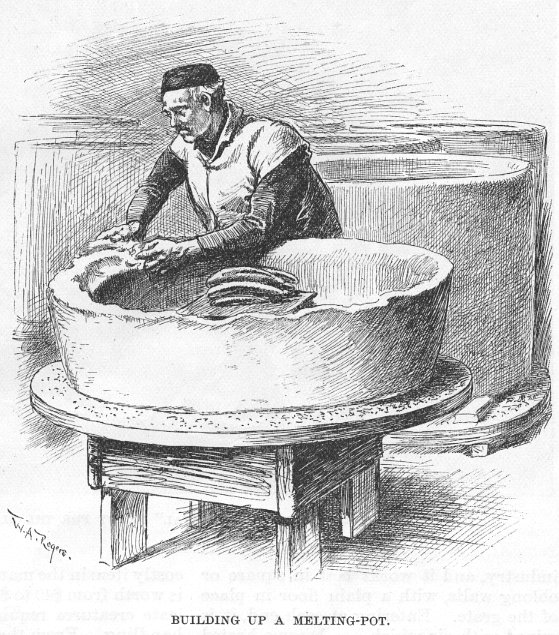
we must look at the furnaces and melting-pots. The melting furnace is the
backbone of the establishment. In this the rough ingredients are converted
by intense heat into molten glass or "metal," for the workmen to shape as
they please.
The form of this furnace is either circular or
rectangular, according to the kind of glass to be produced and the fuel
used.
|
Flint-glass furnaces are usually round, taking the form of a conical
kiln, which is surmounted by a mammoth chimney.
BUILDING-UP A MELTING-POT.
At its base are from eight to twelve crucibles ranged
in a circle about the central grate fire, which is supplied with coal fuel
and with air from underground approaches. This is the traditional furnace
for melting. It receives the covered crucibles through large arches on
every side, which are closed by fire-bricks and clay, concealing all but
the openings of the crucibles. This form is modified to a rectangular
shape for window, plate, and bottle glass, with doors at each end. The
open pots are put in through these doors, and their contents withdrawn
through openings in two rows at the sides. Gas is rapidly displacing other
fuel in this
|