Up: Sediver

Sediver Catalog 1970
9 of 136
|
|
| |
The constituent parts of the insulators
An insulator is a heterogeneous whole consisting of different parts:
a) the dielectric of toughened glass
b) the metal parts: cap and pin
c) the assembly material: cement mortar.
a) the dielectric of toughened glass
Its electrical qualities derive from its chemical composition which
was chosen to obtain an insulator having great dielectrical rigidity
under impulse waves and industrial frequency voltage, even in those
parts of the globe having extreme climates.
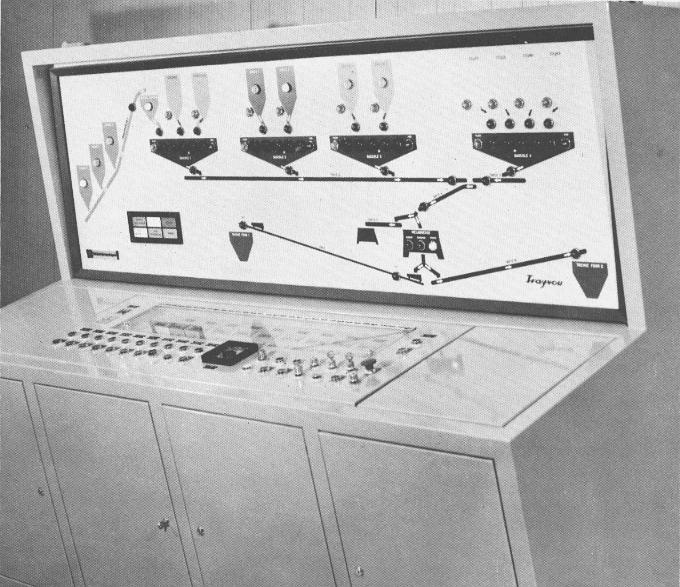
Automatic control of the glass chemical composition
Figure 1 shows the lay-out of the continuous production
line of the dielectrics. The raw materials are chosen as a function of
their composition, and the regularity of same, which is checked periodically
by chemical and granulometric analyses. The raw materials are mixed in
predetermined proportions which are checked thanks to the automatic
installation shown in Figure 2. Besides the regular chemical analyses, the
regularity of the batch and the homogeneity of the glass prepared in the
furnace are checked daily by very precise densimetric measurements.
Toughening gives to the glass a very great mechanical resistance which
is used all the better when they have a carefully determined shape.
The shape and the mechanical resistance of the glass are checked by
means applied as soon as its temperature permits. The observations are
analysed by the control chart method. Routine tests complement the
statistical checks: a cold-hot thermal shock eliminates pieces with
heterogeneities and a hot-cold thermal shock has as its aim the
destruction of those glass units having improper thermal stresses.
Finally each piece undergoes a visual examination designed to
eliminate those having defects, internal or external, visible to the
naked eye.
|
|