Up: Glassmaking

Gilbert: 20 of 65
|
|
| |
rod to the opposite end of the cylinder (see right of Fig. 1), and
the blower and helper walk backward away from each other to pull
the cylinder into a tube. Of course, they use a small amount of
glass to make small tubes, and larger amounts for large tubes.
MOLDED GLASS
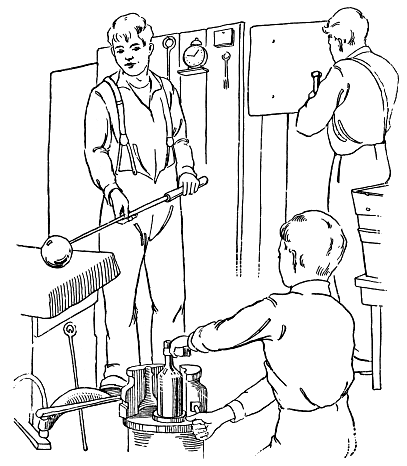
Many articles of glass are made by blowing
the glass into molds. Bottles are made in this way
(Fig. 23), and large machines are now in use which
mold many bottles at one time in this way.
PRESSED GLASS
Many articles are made by pressing glass
into molds, that is, the molten glass is poured into molds and is
pressed against the sides of the mold by means of a plunger.
Imitation cut glass is pressed in this way.
PLATE GLASS
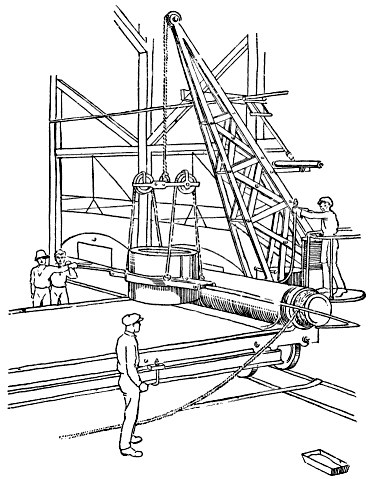
The large sheets of plate glass used in
store windows are not blown, but rolled. The molten glass is poured
from the fire clay pots upon a cast-iron table and is rolled flat
by means of a large iron roller (Fig. 24). The glass
is then in the shape of plate glass, but is rough on both sides. It is
annealed for a number of days and then is ground smooth on both sides,
first with coarse emery, then with finer and finer emery, and is finally
polished with rouge. The result is the beautifully polished plate glass
we see in large windows.
OPTICAL GLASS
The United States and Great Britain made
great strides in the manufacture of optical glass during the war
and there are now many kinds on the market. They are used in
making the lenses, prisms, and mirrors for optical instruments.
Optical glass is made in much the same way
as ordinary glass
|
|