Up: Glassmaking

Gilbert: 61 of 65
|
|
| |

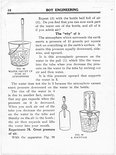
FIG. 98
WATER DRIVEN UP
TUBE BY
ATMOSPHERE
|
Repeat (3) with the bottle half full of air (4).
Do you find that you can now suck part of the water out of the bottle,
and all of it if you admit air?
The "why" of it
The atmosphere which surrounds the earth exerts
a pressure of 15 pounds per square inch at the earth's surface. It
exerts this pressure equally downward, sidewise, and upward.
It is this atmospheric pressure on the water in
the pail (1) which lifts the water into the tube when you decrease the
pressure on the water in the tube by sucking out air and then water.
It is this pressure upward that supports the
water in 2.
The water does not rise in 3 because the
atmosphere cannot exert pressure downward on the water in the bottle.
The rise of the water in 4 is due to another
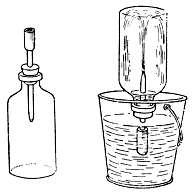
FIG. 99
A FOUNTAIN
|
fact, namely, that any gas expands when the pressure on it is decreased.
When you suck air out of the tube you decrease the pressure on the water
in the tube and thereby on the air in the bottle; the air then expands
and lifts the water into your mouth.
Experiment 74. Great pressure of air.
With the apparatus Fig. 98
|
|