but great care is taken; first, to see that the materials are pure;
second, to stir the glass constantly, as it cools from the molten
to the viscous state, to make it as uniform as possible; and third,
to cool it very slowly in the annealing process, to avoid strains.
QUARTZ GLASS
An entirely new glass has been placed on the
market in quantities in recent years. It is made by melting very
pure quartz sand at a temperature of 3000° F. and cooling it
fairly rapidly. It has the very valuable property of expanding and
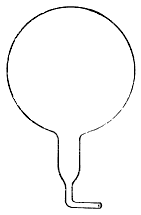
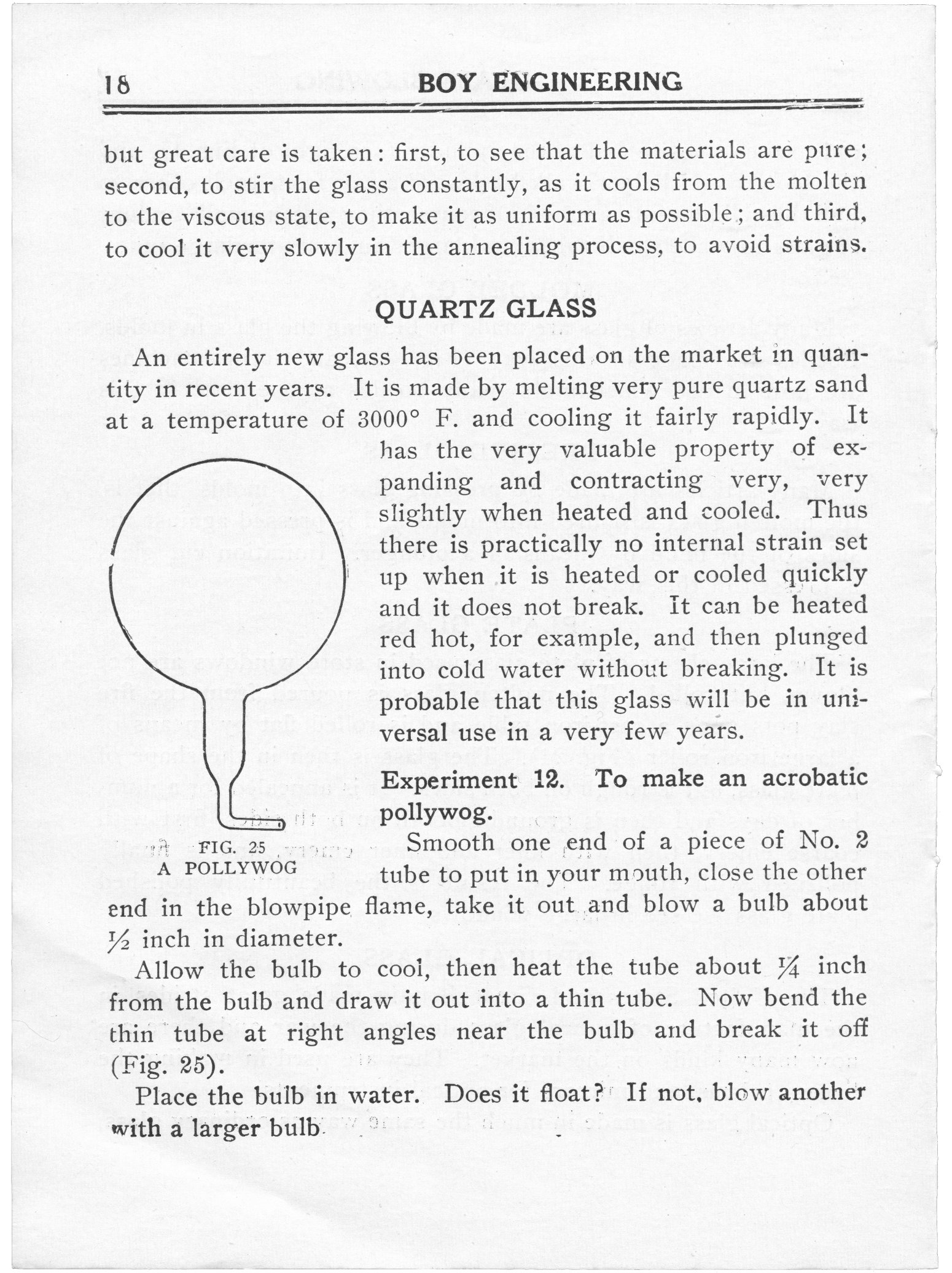
FIG. 25
A POLLYWOG
|
contracting very, very slightly when heated and cooled. Thus there
is practically no internal strain set up when it is heated or cooled
quickly and it does not break. It can be heated red hot, for example,
and then plunged into cold water without breaking. It is probably
that this glass will be in universal use in a very few years.
Experiment 12. To make an acrobatic pollywog.
Smooth one end of a piece of No. 2 tube to
put in your mouth, close the other end in the blowpipe flame, take
it out and blow a bulb about ½" inch in diameter.
Allow the bulb to cool, then heat the tube
about ¼ inch from the bulb and draw it out into a thin tube.
Now bend the thin tube at right angles near the bulb and break it
off (Fig. 25).
Place the bulb in water. Does it float?
If not, blow another with a larger bulb.
|