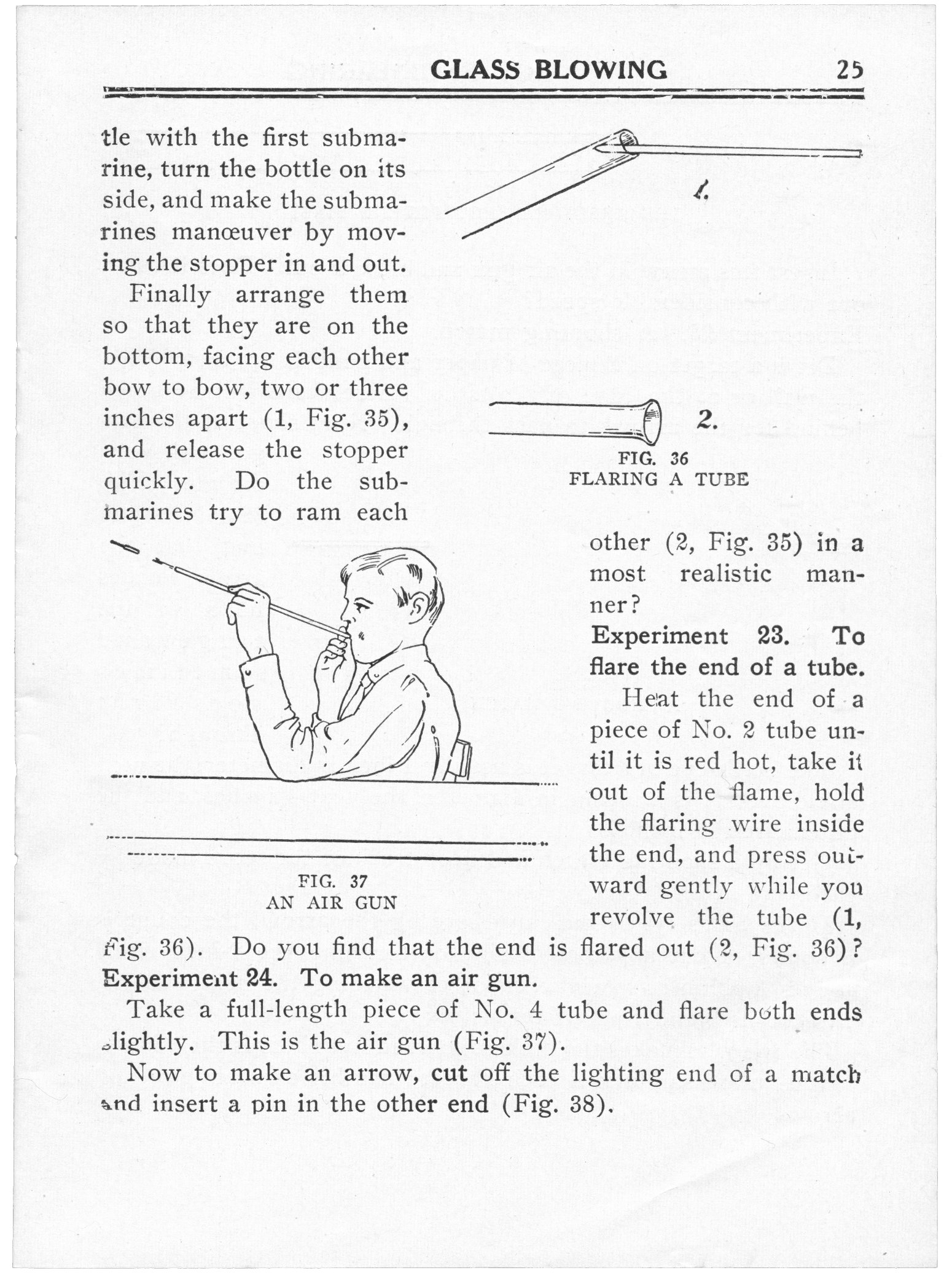
FIG. 36
FLARING A TUBE
|
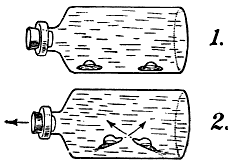
with the first submarine, turn the bottle on its side, and make the
submarines manœuver by moving the stopper in and out.
Finally, arrange them so that they are on the
bottom, facing each other bow to bow, two or three inches apart (1,
Fig. 35), and release the stopper quickly. Do the
submarines try to ram each other (2, Fig. 35) in a
most realistic manner?
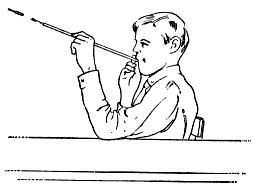
FIG. 37
AN AIR GUN
|
Experiment 23. To flare the end of a tube.
Heat the end of a piece of No. 2 tube until it is
red hot, take it out of the flame, hold the flaring wire inside the end,
and press outward gently while you revolve the tube (1, Fig. 36). Do you
find that the end is flared out (2, Fig. 36)?
Experiment 24. To make an air gun.
Take a full-length piece of No. 4 tube and flare
both ends slightly. This is the air gun (Fig. 37).
Now to make an arrow, cut off the lighting end
of a match and insert a pin in the other end (Fig. 38).
|