Up: Glassmaking

Gilbert: 24 of 65
|
|

| |
Experiment 15. To make a glass spider-web.
Heat the end of a piece of No. 2 tube in
the blowpipe flame until it is melted and very hot. Now touch
the end of another piece of glass to the melted glass, remove
from the flame, and quickly pull the two pieces apart as far as
you can (Fig. 28). Do you find that you have pulled part of the
melted glass out into a very fine glass spider-web?
Repeat, but ask a friend to touch the
second piece of glass to the first and run away as fast as he can.
Do you get a much finer spider-web?
Is the glass spider-web fairly strong and
very flexible?
Experiment 16. The ancient spider trick.
Attach an imitation spider-- or the dead
body of a real spider-- to the end of the glass spider-web and
surprise your friends, as shown in Fig. 29.

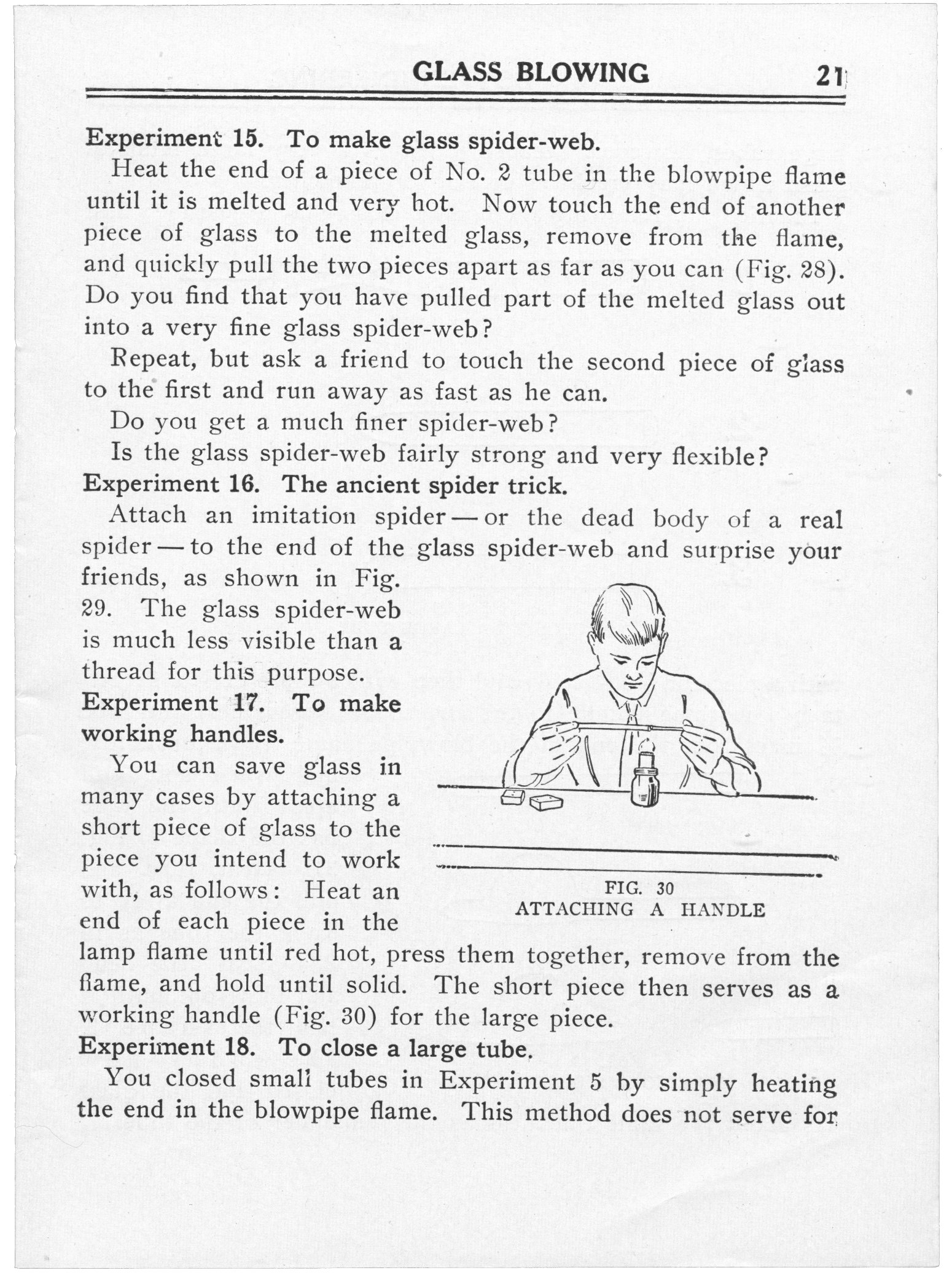
FIG. 30
ATTACHING A HANDLE
|
The glass spider-web is much less visible than a thread for this
purpose.
Experiment 17. To make working handles.
You can save glass in many cases by
attaching a short piece of glass to the piece you intend to work
with, as follows: Heat an end of each piece in the lamp flame until
red hot, press them together, remove from the flame, and hold
until solid. The short piece then serves as a working handle
(Fig. 30) for the large piece.
Experiment 18. To close a large tube.
You closed small tubes in Experiment 3
by simply heating the end in the blowpipe flame. This method does
not serve for
|
|