Up: Glassmaking

Gilbert: 59 of 65
|
|
| |
4 inches long and another about 3 inches, stand
them upright in a pan of water, light them, and invert a wide-mouthed
bottle over them. Does some air escape at first due to expansion, do
both candles go out, the taller one first, and does the water rise until
the bottle is abut one-fifth full?
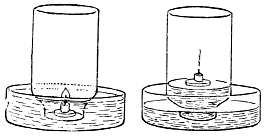
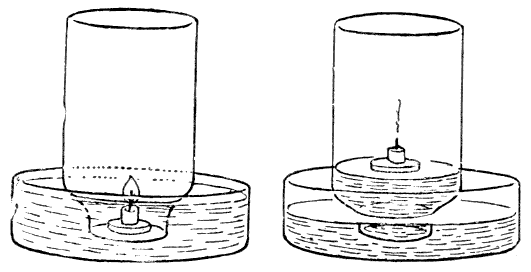
FIG. 95
THE CORK RISES
|
Cut a piece of candle ½ inch long, float
it on a flat cork or can cover in the pan of water, light it, and invert
a fresh empty bottle over it (Fig. 95). Is the result similar?
The "why" of it
The water rises in the bottle because
1/5 of the air is used up by the burning candle. Air is
1/5 oxygen and 4/5 nitrogen. The oxygen
unites with the burning gas of the candle and produces water vapor
(H2O) and carbon dioxide (CO2); the nitrogen takes
no part in the burning.

FIG. 96
WATER FROM
FLAME
|
The water vapor (H2O) condenses to
water on cooling and takes up very little space. The carbon dioxide
remains a gas and occupies space, but this is offset by the volume of
the air which escaped at first. The result is that the volume of gas
at the end is about 1/5 less, and the atmospheric pressure
on the water in the pan lifts water into the bottle.
The candle goes out because it must have oxygen
to burn and the oxygen is used up.
Experiment 72. Water produced by fire.
It is certainly magic to produce water from
fire, but you can do it easily as follows:
|
|