Up: Glassmaking

Gilbert: 53 of 65
|
|
| |
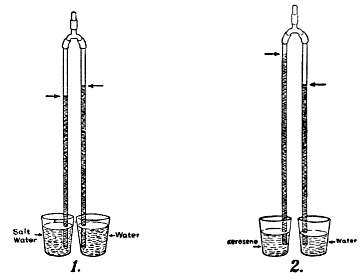
gasoline or kerosene is longer than the column of water (2,
Fig. 83)? It is longer because gasoline and kerosene
are lighter than water.
Experiment 64. To fuse wire into glass.
Find a piece of thin iron or copper wire about
4 inches long, heat the end of a piece of No. 2 tubing until it is
nearly closed, insert the iron or copper wire into the small hole, and
heat the glass around the wire until it shrinks and grips the wire
firmly (Fig. 84). The glass then serves as a handle for the wire.

FIG. 84
WIRE FUSED INTO GLASS
|
It is difficult to make a secure joint between
iron or copper wire and glass because they both expand and contract
more than glass when heated and cooled. It is easy to make a secure
joint between platinum wire and glass because platinum and glass expand
and contract at practically the same rate when heated and cooled.
Platinum, however, is too expensive to be used for ordinary experiments.
Experiment 65. To cut window glass.
The common glass cutter is a small very hard
steel wheel

FIG. 85
A GLASS CUTTER
|
mounted on a handle (Fig. 85). Practice with one on a
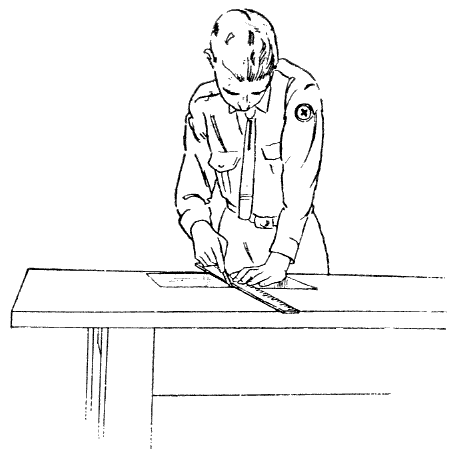
pane of glass: place a ruler on the glass, draw the wheel along the
ruler (Fig. 86) with sufficient pressure to scratch
the glass, place the under side of the scratch exactly over the edge of
the table, and press down on both sides.
|
|