Up: Glassmaking

Gilbert: 52 of 65
|
|
| |
pressure in the two tubes, and the atmospheric pressure on the water
in the tumblers lifts the water into the tubes.
Experiment 63. Unequal columns.
Put a large handful of salt into a tumbler
partly filled with water and stir until the salt is dissolved. Now
pour fresh water into another tumbler until it is at the same height
as the salt water. Make the arms of equal length, put one arm in
the salt water and the other in the fresh water, then suck a little
air out of the top coupling and close it with a plug. Do you find
that the column of salt water is shorter than the column of fresh
water (1, Fig. 83)? It is shorter because salt water is heavier than
fresh water.
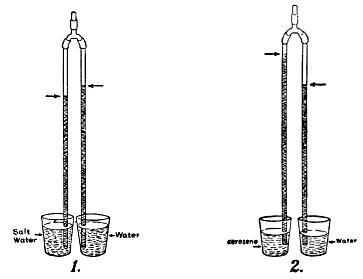
FIG. 83
UNEQUAL COLUMNS
|
If you have gasoline or kerosene convenient
till one tumbler half full of either, and the other tumbler half
full of water, then repeat the experiment. Do you find that the
column of
|
|