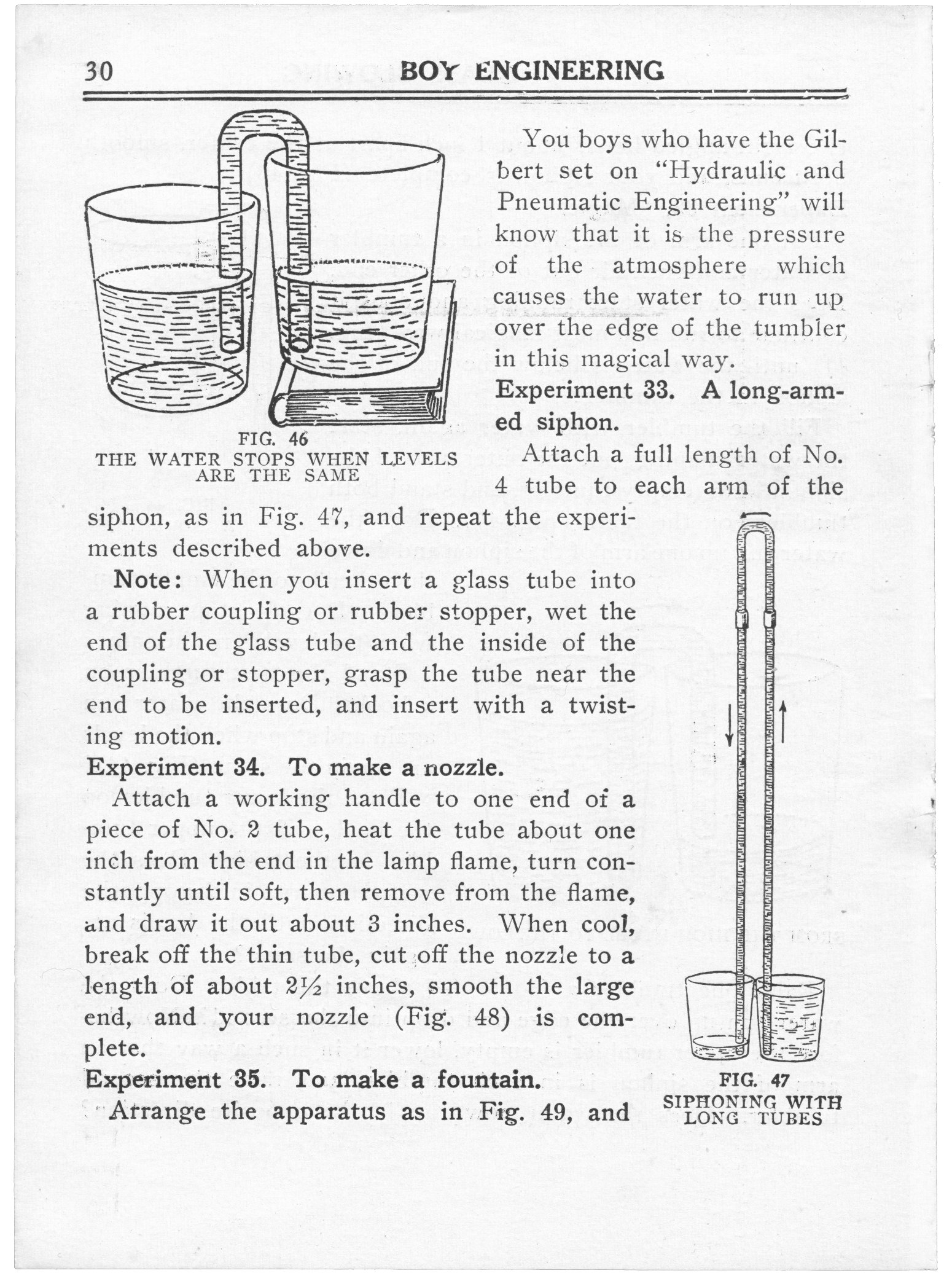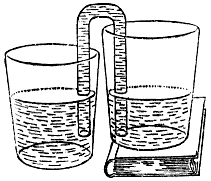
FIG. 46
THE WATER STOPS WHEN LEVELS
ARE THE SAME
|
You boys who have the Gilbert set on
"Hydraulic and Pneumatic Engineering" will know that it is the
pressure of the atmosphere which causes the water to run up over
the edge of the tumbler in this magical way.
Experiment 33. A long-armed siphon.
Attach a full length of No. 4 tube to each
arm of the siphon, as in Fig. 47, and repeat the experiments
described above.

FIG. 47
SIPHONING WITH
LONG TUBES
|
Note: When you insert a glass tube
into a rubber coupling or rubber stopper, wet the end of the glass
tube and the inside of the coupling or stopper, grasp the tube near
the end to be inserted, and insert with a twisting motion.
Experiment 34. To make a nozzle.
Attach a working handle to one end of a
piece of No. 2 tube, heat the tube about one inch from the end
in the lamp flame, turn constantly until soft, then remove from
the flame, and draw it out about 3 inches. When cool, break off
the thin tube, cut off the nozzle to a length of about 2½
inches, smooth the large end, and your nozzle
(Fig. 48) is complete.
Experiment 35. To make a fountain.
Arrange the apparatus as in
Fig. 49, and
|